
Ecommerce Order Fulfillment Process: 7 Stages and What to Measure
Quick answer: The ecommerce order fulfillment process is the loop that turns stock into delivered orders and then back into fresh stock. It has seven stages: receive and check inventory, store it by SKU, capture and route each order, pick, pack, ship with tracking, then handle returns and reorder. Most guides stop at shipping, but the first and last stages decide whether the middle runs smoothly. Give every stage an owner and one number to watch, and you will spot problems before your customers do.
The cycle at a glance
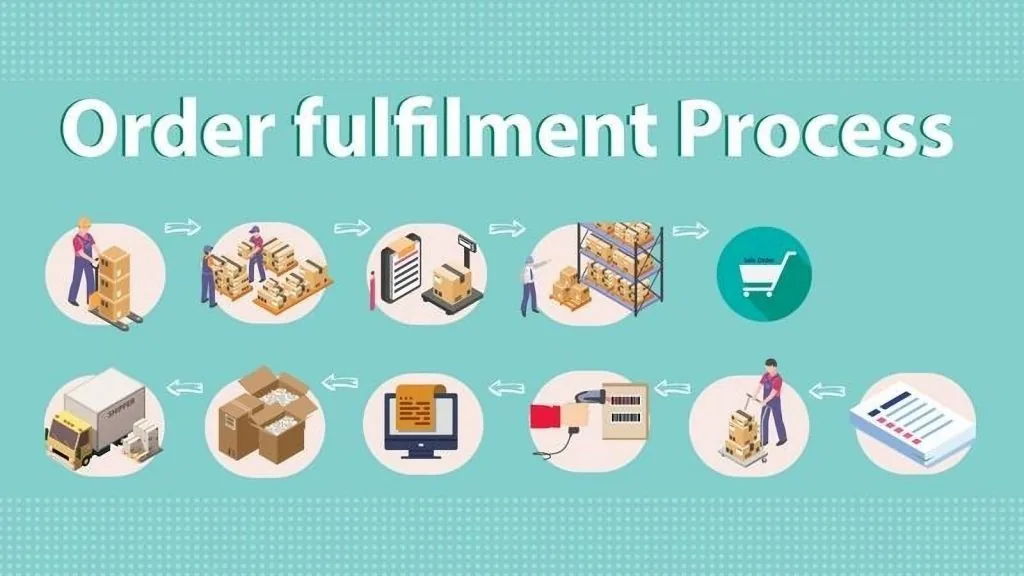
Think of fulfillment as a circle, not a line. Stock comes in, orders go out, returns and reorders bring stock back in. The table below is the whole circle on one screen. The column to pay attention to is the third one: each stage has a single measure that tells you whether it is healthy.
| Stage | What happens | Number to watch | Typical failure |
|---|---|---|---|
| 1. Receiving | Inbound cartons are counted against the purchase order and inspected | Dock-to-stock time: hours from arrival to sellable | Defects discovered by customers instead of at the door |
| 2. Storage | Each SKU gets a fixed location; system count matches the shelf | Inventory accuracy: share of SKUs where counted stock equals system stock | Selling stock that isn't there |
| 3. Order capture and routing | Paid orders reach the warehouse, addresses are checked, holds applied | Handoff time: hours from payment to the order reaching the warehouse | Orders stuck because a variant was never linked to a SKU |
| 4. Picking | Items are pulled from their locations | Pick accuracy: share of orders picked without error | Wrong size or color shipped |
| 5. Packing | Box chosen, item protected, inserts added, parcel weighed | Damage rate: share of orders arriving damaged | Oversized boxes that inflate the shipping bill |
| 6. Shipping and tracking | Label and customs data, carrier handover, tracking sent to the store | Order-to-dispatch time | A label printed for a parcel that hasn't moved |
| 7. Returns and replenishment | Returns checked and restocked; reorders placed before stock runs out | Stockout days per SKU, and return rate by reason | Reordering after the shelf is already empty |
Stages 1–2: the work before any order arrives
Receiving is where cheap problems stay cheap. A carton short by 20 units is a message to the supplier on day one. The same shortage found three weeks later is a run of oversold orders and refunds. Count every inbound delivery against the purchase order, inspect a sample of units, and photograph anything wrong. Our inspection page explains how we check batches on arrival.
Storage is about one rule: one SKU, one barcode, one known location. Inventory accuracy falls apart when two variants share a barcode or when stock is put "wherever there's space". A short weekly count of your top sellers catches drift early.
Stages 3–6: from checkout to the carrier
This is the part most people mean by fulfillment, and the part a warehouse calls order processing. We break it into eight smaller steps in what order processing means. At the level of the whole cycle, four habits matter most:
- Map every variant before you launch it. A store variant with no matching SKU can't be picked, so the order sits at "unfulfilled" until someone notices. Our Shopify order status guide explains what each status asks you to do.
- Combine multi-item orders. One parcel instead of two halves the labels, the handovers and, from China, the customs entries.
- Right-size the packaging. Carriers often bill light, bulky parcels by dimensional weight, so a box that is too big costs money on every order.
- Send tracking only after the handover. A tracking number that shows "label created" for three days generates more "where is my order?" emails than no number at all.
In 2026 this stage also includes duties. US de minimis no longer covers parcels from China, so every parcel needs accurate customs data and its duty cost belongs in your price. We explain the shipping side in our international shipping guide.
Stage 7: closing the loop
Returns and replenishment get the least attention and cause the most stockouts. Two habits fix most of it:
- Record why things come back. "Too small", "arrived broken" and "not as pictured" point to different fixes: a size chart, packaging, or product photos. A return rate without reasons tells you nothing.
- Reorder from lead time, not from panic. If restocking a product from the factory takes four weeks door to door, the reorder has to go out while you still have more than four weeks of stock. We show the math in 3PL in supply chain management.
Replenishment is where order fulfillment hands over to the wider chain of suppliers, factories and freight; supply chain fulfillment covers that upstream half.
Where the time goes: three example timelines
How long fulfillment takes depends mostly on where the stock sits when the order arrives. Here is how it works at PackQuay, using our published service times:
| Situation | Before dispatch | After dispatch |
|---|---|---|
| Stock already in our China warehouse | Leaves within 24 hours (48 at peak) | Transit time of the shipping line you choose |
| Not in stock: bought after the order | Purchasing averages 4–5 days after payment, then inspection and packing | Same as above |
| Best-seller placed in an overseas 3PL warehouse | Ships from inside the destination market | Delivered in 1–5 days |
The middle row is the dropshipping version of the cycle: stages 1 and 2 happen after the customer pays, which is why it is slower. Our dropshipping order fulfillment guide walks through that version step by step.
Map your own process in 30 minutes
You don't need software to find your weak stage. Take last month's orders and answer these questions:
- How many hours did new stock wait before it could be sold?
- How many orders went out wrong, and at which stage did the mistake happen?
- What was the slowest payment-to-dispatch time, and why?
- How many days was each top-10 SKU out of stock?
- What were the top three return reasons?
- Who owns each of the seven stages? If the answer is "nobody" or "everyone", that's your first fix. Our guide to the fulfillment specialist role shows who usually does what.
If you want to see how the parts of the cycle fit together through records and data, read what an ecommerce fulfillment system is.
How PackQuay runs the cycle for you
We run stages 1 to 6 in our own warehouse in Xinxiang, Henan: receiving with 20% of each batch inspected free, storage by SKU (free for your first 2 months, and while you have orders to process), then picking, packing in your branded packaging and dispatch on 30+ shipping lines. Multi-item orders leave as one parcel. Message us on WhatsApp and we connect your Shopify or WooCommerce store for you. Orders come in automatically, and tracking numbers go back to your store once parcels ship. You can also send orders as a CSV or Excel file. Pick and pack starts at $2.00 per order and falls to $1.00 as daily volume grows; see pricing or talk to us on WhatsApp.
FAQ
What are the stages of the ecommerce order fulfillment process?
Seven stages form a loop: receiving and inspecting stock, storing it by SKU, capturing and routing each order, picking, packing, shipping with tracking, and finally returns and replenishment, which feed stock back into the start.
What is the difference between order fulfillment and order processing?
Order processing is the warehouse work between an order arriving and the parcel being handed to a carrier. Order fulfillment is the wider cycle, which also includes receiving stock before any order exists and handling returns and reorders afterwards.
How long should order fulfillment take?
It depends on where the stock is. At PackQuay, stocked orders leave within 24 hours (48 at peak); items bought after the order add about 4–5 days of purchasing on average; best-sellers held in an overseas warehouse are delivered in 1–5 days.
Which fulfillment metrics should a small store track?
One per stage is enough: dock-to-stock time, inventory accuracy, order handoff time, pick accuracy, damage rate, order-to-dispatch time, and stockout days plus return reasons.
Is the fulfillment process different for dropshipping?
The stages are the same, but the order comes first: the item is bought, received and inspected after the customer pays, so delivery takes longer and supplier stock becomes the main risk.