
What Is Order Processing? 8 Steps From New Order to Dispatch
Quick answer: Order processing is the work done between an order arriving and its parcel being handed to a carrier: checking the order, securing the stock (buying it first if needed), inspecting, picking, packing, labeling and dispatching. It ends where shipping begins, which is why stores show processing time and shipping time as two separate numbers. For items already on the shelf, processing should take about a day. For items bought after the order, add the sourcing time. Most delays happen in the first two steps, not at the packing table.
Order processing, fulfillment and management: where each starts and stops
The three terms overlap, and suppliers use them loosely. Here is how they nest:
| Term | Starts | Ends | Who mainly does it |
|---|---|---|---|
| Order processing | Order received by the warehouse | Parcel handed to the carrier | The warehouse |
| Order fulfillment | Customer pays | Parcel delivered, returns handled | Warehouse plus carriers |
| Order management | Customer checks out | Last refund or return closed | The seller, through the store or an OMS |
This guide stays inside the warehouse. For the whole journey from checkout to doorstep, see dropshipping order fulfillment; for the record-keeping side, see what order management covers.
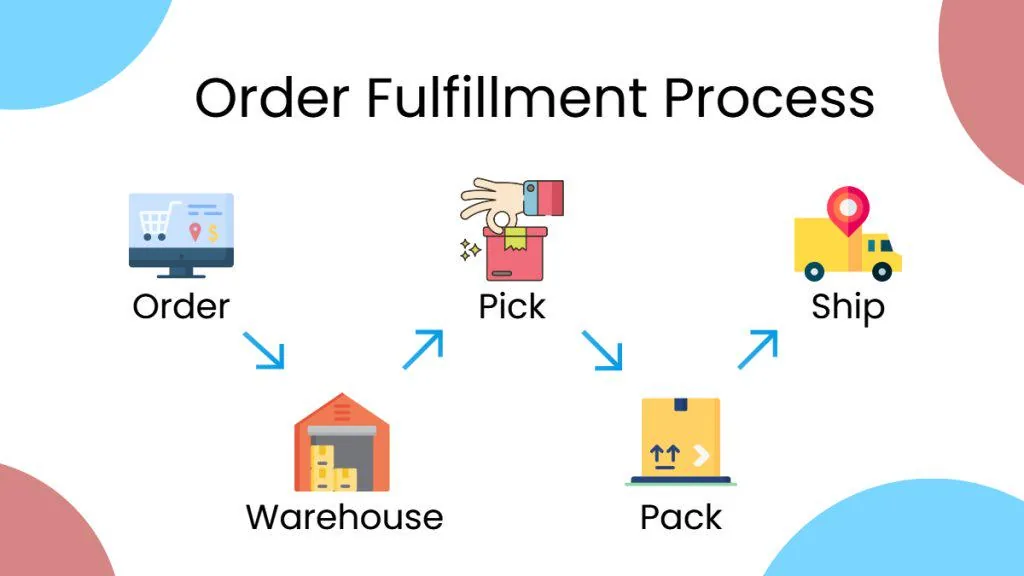
The 8 steps inside the warehouse
1. Intake and order check
The order arrives from the store, usually by integration, sometimes by spreadsheet. Before anything moves, it gets checked: is it paid, is the address complete, is every line linked to a real product on the shelf, is anything flagged as risky? What stops it here: a variant you added to the store but never linked, an address missing an apartment number, or, with prepaid partners, an empty account balance.
2. Allocation: stock or source?
The system looks for each item. If it's on the shelf, units are reserved for this order so nobody else's order takes them. If not, a purchase is triggered. This is the fork that decides whether the order takes one day or several.
3. Purchasing and receiving (no-stock orders only)
For dropshipped items, the warehouse buys from the factory or wholesaler, waits for the delivery and books it in. This is the longest step by far. At PackQuay, sourcing for no-stock orders averages 4–5 days after payment. When an order holds items from several suppliers, it waits for the slowest one.
4. Inspection
Goods are checked against what you sell: right item, right color and size, no damage, nothing missing. We inspect 20% of goods by default at no charge, and faulty or mismatched items go back to the supplier for replacement. Skipping this step doesn't save time; it moves the inspection to your customer.
5. Picking
A picker collects the items from their shelf locations using a pick list. Warehouses usually pick in batches, gathering the same SKU for many orders in one trip, then sort the items back into individual orders.
6. Packing
All items of the order go into one parcel, in the packaging set for that product: a poly mailer, a padded mailer or a box, plus protection for anything fragile. This is also where branding happens: your custom box or mailer, insert card or gift note.
7. Weighing, labeling and customs data
The parcel is weighed, a shipping line is chosen for the destination, and the label prints. For international parcels, the customs declaration lists the contents and their value. Since the US $800 duty-free threshold no longer applies to parcels from China, every US parcel owes duty, so it should travel duties paid (DDP), with the cost already built into your price, rather than the carrier billing your customer at the door.
8. Handover and tracking
The carrier collects the parcel and scans it in. That handover, and only that, should trigger the tracking number going back to your store, which marks the order shipped and emails the customer. Processing ends here; transit begins.
How long processing takes
| Order type | Steps involved | Processing time at PackQuay |
|---|---|---|
| Stocked order | 1, 2, 4–8 (inspection happened when the stock arrived) | Leaves within 24 hours; 48 at peak |
| No-stock (dropshipped) order | All 8 | Sourcing averages 4–5 days after payment, then the stocked-order steps |
| Order during a Chinese national holiday | Paused at step 8 | Dispatch waits until couriers run again |
The gap between the first two rows is the strongest argument for holding stock of anything that sells every day. Our comparison of dropshipping vs. holding stock works out when that switch pays.
What slows processing, and who can fix it
| Delay | Step | Who fixes it |
|---|---|---|
| Unlinked product variant | 1 | You: link every variant before you publish it |
| Unpaid invoice | 1 | You: settle it before orders are held |
| Incomplete or invalid address | 1, 7 | You and the customer |
| Supplier stock-out | 3 | Your agent, with a backup supplier; you decide on a swap or refund |
| Order waiting on its slowest supplier | 3 | Both: hold stock of the slow item, or ship in two parcels |
| Defective units found | 4 | Your agent, by getting replacements from the supplier |
| Custom packaging not ready | 6 | You: order packaging before the product launches |
| Peak season and holidays | All | Both: stock up early and adjust your promise |
Most of these can be prevented at setup. When one does slip through on Shopify, the order shows up as stuck in the admin; our guide to pending fulfillment covers how long is too long.
Processing time vs shipping time: what to show customers
Customers experience one wait, from payment to doorstep, but it has two parts you should show separately:
- Processing time is the warehouse's part, and the part you control. Base it on the table above: a day or two for stocked items, the sourcing time plus a margin for dropshipped ones.
- Shipping time is the carrier's part. It depends on the shipping line and destination; our international shipping guide covers how to set it.
Showing them apart helps in two ways: customers know the order hasn't been forgotten during processing, and your support team can tell at a glance which half of the promise is running late.
How PackQuay processes your orders
Every step above happens in our own warehouse in Xinxiang, Henan: our team buys, receives, inspects, picks and packs, so there is no hand-off to anyone else before the carrier. Orders arrive from Shopify and WooCommerce automatically or by CSV or Excel upload from other platforms, multi-item orders leave as one parcel, and tracking reaches your store only after physical dispatch. Pick and pack starts at $2.00 per order and drops to $1.00 as your daily volume grows (see pricing), with no subscription. Ask about your products on WhatsApp.
FAQ
What does order processing mean?
It is the warehouse work between receiving an order and handing the parcel to a carrier: checking the order, securing or buying the stock, inspecting, picking, packing, labeling and dispatch.
What is the difference between order processing and order fulfillment?
Order processing ends when the parcel leaves the warehouse. Order fulfillment is wider: it also includes the carrier's transit, delivery and any returns.
How long does order processing take?
For items already in stock, about a day; PackQuay dispatches stocked orders within 24 hours, or 48 at peak. Items bought after the order take longer because they must be sourced first, which averages 4–5 days with us.
Why does processing time differ from shipping time?
Processing time covers the warehouse's work before dispatch; shipping time is the carrier's transit afterward. Stores show them separately so customers know which part of the wait they're in.
What is the slowest step in order processing?
For dropshipped items, purchasing: the product has to be bought and delivered to the warehouse before it can be checked and packed. Holding stock of best sellers removes that step.