What Is Supply Chain Fulfillment? From Factory Order to Doorstep
Quick answer: Supply chain fulfillment is all the work that makes it possible to deliver what customers order: planning and buying stock, producing and inspecting it, moving it to the right warehouse, and then picking, packing, shipping and handling returns. Order fulfillment is only the last stretch of it. For an online store, the biggest design choice is where a customer's order enters the chain. Does it pull an item off a shelf near the customer, off a shelf in China, from a supplier's stock, or from a production line? That one choice sets your delivery time, the cash you tie up in stock and the risks you carry.
Supply chain fulfillment vs order fulfillment
| Order fulfillment | Supply chain fulfillment | |
|---|---|---|
| Starts when | A customer pays | You decide what to sell and how much to buy |
| Covers | Pick, pack, ship, track, returns | Planning, sourcing, production, inspection, freight, storage, then order fulfillment |
| Time frame | Hours to days | Weeks to months |
| Key decisions | Which box, which shipping line | Which supplier, how much stock, where to hold it, when to reorder |
| Typical failure | A late or wrong parcel | No stock to ship at all, or too much of the wrong thing |
A store can have flawless packing and still fail its customers because the supply chain behind it ran dry. For the step-by-step view of the last stretch, see the order fulfillment process.
Where does the order enter your chain? Four strategies
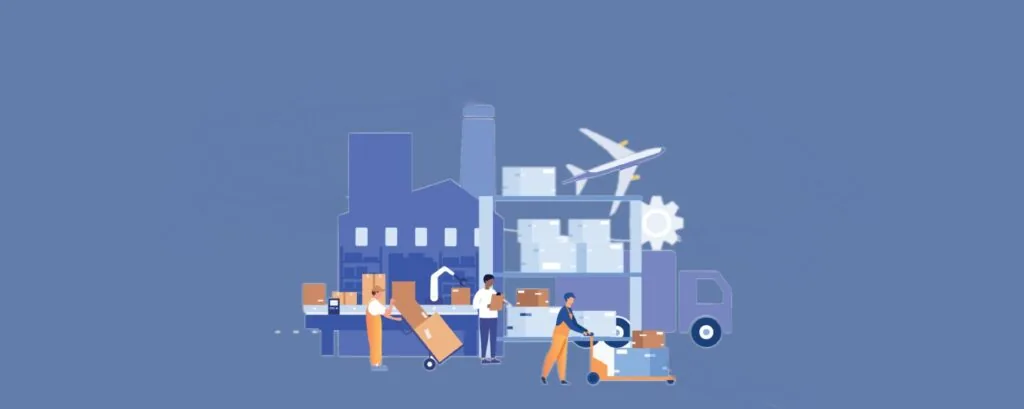
Supply chain planners call the point where a customer order meets your stock the decoupling point. Everything before it runs on forecasts; everything after it runs on real orders. For a store selling products made in China, there are four realistic places to put it:
| Strategy | The order triggers | Time to customer | Cash in stock | Main risk | Fits |
|---|---|---|---|---|---|
| 1. Ship from stock near the customer | A domestic pick and ship | Shortest | Highest | Overstock, with duty already paid on it | Proven best-sellers |
| 2. Ship from stock in China | An international pick and ship | Dispatch plus international transit | Medium | Per-parcel duty, longer transit | Steady sellers, wide ranges |
| 3. Buy to order (dropshipping) | A purchase from the supplier, then inspection and shipping | Longer: purchasing time is added | None | Supplier runs out or quality varies | Testing, the long tail |
| 4. Make to order | A production run (custom or personalized items) | Longest | Raw materials only | Production delays | Personalized products |
With PackQuay's published service times as an example: strategy 2 means stocked orders leave our China warehouse within 24 hours (48 at peak); strategy 3 adds purchasing, which averages 4–5 days after payment; strategy 1, a best-seller placed in one of our overseas 3PL warehouses, means delivery in 1–5 days. Most growing stores use more than one strategy at once, product by product. When to move a product from strategy 3 to 2 is covered in dropshipping vs ecommerce fulfillment.
The four flows you have to manage
- Goods: factory to warehouse to customer, and back again for returns. Each handoff is a place where units get lost, damaged or miscounted.
- Information: orders, stock counts, inspection results, tracking numbers. Most supply chain failures are information failures: someone didn't know stock was low, or a batch was faulty. The ecommerce fulfillment system guide shows which records have to move between store and warehouse.
- Money: deposits to factories, freight, duties, fulfillment fees, and customer payments arriving weeks later. The gap between paying the factory and being paid by the customer is the cash your strategy ties up.
- Returns: products coming back, with reasons that should flow upstream to the supplier and the product page.
How to measure supply chain fulfillment
Four numbers cover most of what a small brand needs to know:
| Metric | How to calculate it | What it tells you |
|---|---|---|
| Perfect order rate | Perfect orders ÷ all orders × 100. An order is perfect only if it arrived complete, on the promised date, undamaged and with correct paperwork | The customer's view of the whole chain |
| Fill rate | Units shipped from stock when ordered ÷ units ordered × 100 | Whether your stock planning keeps up with demand |
| Order cycle time | Days from payment to delivery, average and slowest 10% of orders | Whether your delivery promise is honest |
| Days of stock | Units on hand ÷ average units sold per day | How long until you run out, and whether you hold too much |
The perfect order measure comes from the SCOR model published by ASCM, a supply chain professional association, which defines it as the share of orders delivered complete, on time, undamaged and with accurate documentation. It is strict on purpose: one miss on any point and the order doesn't count. To turn days of stock into a reorder date, add up your full lead time from China; we work through that math in 3PL in supply chain management.
Where China-sourced supply chains usually break
- Supplier stock runs out. Under strategy 3, your stock is someone else's stock. Keep a small buffer of best-sellers or a second supplier for each hero product.
- Quality drifts between batches. The sample you approved isn't always the batch you get. Inspect every batch on arrival, not just the first; see product inspection.
- Chinese New Year. Most factories stop for the Spring Festival (February 6 in 2027) and take weeks to return to full speed. Orders for the first quarter need to go in well before it; our Valentine's Day planning guide shows the timeline.
- Duty rules change. US de minimis ended for parcels from China and Hong Kong in May 2025 and for all countries in August 2025; it is repealed by law from July 1, 2027. Every parcel now owes duty, which changes the cost of strategy 2 against strategy 1.
- Slow movers pile up. Stock bought on optimism ties up cash and space. Review days of stock monthly and stop reordering anything with more than you can sell before the season ends.
PackQuay's part of your supply chain
We cover the middle of the chain from our own warehouse in Xinxiang, Henan: sourcing from factories (a fee of 10% of product cost, falling in steps to 4% on large orders), inspection of 20% of each batch free, storage free for the first 2 months and while you have orders to process, and fulfillment on 30+ shipping lines, with 18+ overseas 3PL warehouses for best-sellers. You keep the decisions: what to sell, how much to buy and where to hold it. Message us on WhatsApp and we connect your Shopify or WooCommerce store for you. Orders come in automatically, and tracking numbers go back to your store once parcels ship. You can also send orders as a CSV or Excel file. See product sourcing, or talk to us on WhatsApp.
FAQ
What is supply chain fulfillment?
It is the full chain of work behind delivering customer orders: planning, sourcing, production, inspection, freight and storage, followed by picking, packing, shipping and returns. Order fulfillment is the last part of it.
How is supply chain fulfillment different from order fulfillment?
Order fulfillment starts when a customer pays and ends at delivery. Supply chain fulfillment starts much earlier, with deciding what to buy and from whom, and its failures show up as empty shelves rather than late parcels.
What is a perfect order in supply chain terms?
An order delivered complete, on the promised date, undamaged and with correct documentation. The perfect order rate is the share of all orders that meet every one of those conditions.
Should I ship from China or from a warehouse in my market?
Use both, product by product. Ship from China for new products and wide ranges, where low stock matters most, and move daily best-sellers to a warehouse near your customers, where you pay duty once on a bulk shipment and deliver faster.
How do I stop my supply chain running out of stock?
Track days of stock for each best-seller, know your full lead time from order to warehouse, reorder before days of stock falls below that lead time, and plan around Chinese New Year.