
What Is Supply Chain Integration? Types, Stages and Examples
Quick answer: Supply chain integration means getting the separate parts of a supply chain (suppliers, warehouse, carriers and sales channels) to work from the same information and the same plan, instead of each one optimizing for itself. The term covers two different things: coordination, where independent companies share data and plans, and ownership, where a company buys or builds the next link in the chain (vertical integration) or combines with a peer at the same level (horizontal integration). For a small online brand it almost always means the first: agreeing how orders, stock counts, purchase orders and quality results pass between store, warehouse and suppliers, so nothing gets lost or retyped, and making everyone plan around the same calendar.
Two meanings of "integration"
| Coordination (process and data integration) | Ownership (structural integration) | |
|---|---|---|
| What it means | Partners share data, plans and rules but stay separate businesses | One company owns or controls more links of the chain |
| Small-store example | Your warehouse gets your orders on a fixed routine and sends tracking back; your supplier sees your forecast | A brand buys the workshop that makes its product |
| Cost to start | Low: setup time and some discipline | High: capital, people, management |
| Easy to undo? | Yes, you can change partners | No |
Most articles blend the two. Keep them apart: the coordination kind is available to a one-person store this month, while the ownership kind is a strategy decision for later, if ever.
Types of supply chain integration
| Type | What it means | Example for an online seller |
|---|---|---|
| Vertical, backward | Taking more control of earlier links, toward production | Moving from reselling marketplace listings to a private label product made to your spec by a contracted factory |
| Vertical, forward | Taking more control of later links, toward the customer | A brand that sold only on marketplaces opening its own store so it owns the customer relationship |
| Horizontal | Combining with businesses at the same level | Buying a competing store, or two sellers pooling orders to reach a factory's minimum order |
| Internal | Your own functions working from one plan | Marketing, buying and customer service all seeing the same stock and promotion calendar |
| External, upstream | Sharing plans with suppliers | A factory receiving your forecast before your purchase order arrives |
| External, downstream | Sharing data with warehouses, carriers, marketplaces and buyers | Tracking numbers flowing back to your store and on to the customer |
The four stages of integration
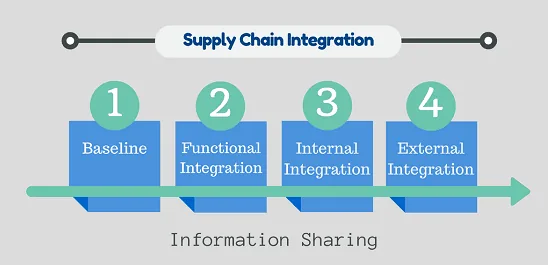
A widely cited model by Graham Stevens, published in 1989, describes integration as a sequence of four stages. It was written about manufacturers, but it maps neatly onto a small online brand:
| Stage | In the original model | In a small online brand |
|---|---|---|
| 1. Baseline | Each function makes its own decisions | Store, supplier chats and a stock spreadsheet all live separately; numbers are retyped |
| 2. Functional integration | Neighboring functions linked, mostly to cut cost | Store and warehouse run one routine: orders go out in one file at a set time, tracking and stock counts come back the same way |
| 3. Internal integration | One plan across the company | The promotion calendar drives purchase orders; everyone works from the same stock figures |
| 4. External integration | Plans shared with suppliers and customers | Suppliers see forecasts, the warehouse hears about promotions ahead of time, inspection results go back to the factory |
Stevens' main point still holds: get your own house in order before you integrate with partners. Sharing a forecast with a factory is pointless if your own marketing and buying plans don't agree. External integration also gets harder with distance: when your supplier is in another country, every plan has to allow for freight, customs and a different holiday calendar. Our guide to global supply chains walks through each of those links.
What to connect first
Start with the link between your store and your warehouse: orders going out, tracking numbers and stock counts coming back, all matched by the same SKUs. At small volumes this doesn't need software. An order file exported at the same time every day, and tracking returned the same way, is already integration, as long as nobody retypes anything. Our guide to SKUs in inventory management covers the matching. Once that runs, the next gains come from the planning and upstream flows that most small stores never set up:
| Information | From → to | How often | What breaks without it |
|---|---|---|---|
| Sales forecast and promotion calendar | You → warehouse and supplier | Monthly, plus two weeks before each promotion | Stockouts mid-campaign, a packing backlog nobody planned for |
| Purchase orders and production status | You ↔ supplier | Each order; weekly during production | Late goods discovered on the delivery date |
| Receiving and inspection results | Warehouse → you and supplier | Each batch | The same defect repeats batch after batch |
| Actual lead time per SKU | Warehouse → you | Each batch | Reorder points built on guesses |
| Landed cost per order | Warehouse and carriers → you | Monthly | Margins calculated on product cost alone |
| Return reasons | Customer service and warehouse → you and supplier | Monthly | Product faults never reach the factory |
None of this needs expensive software at small scale. A shared calendar, a purchase order sheet and inspection photos sent to the supplier after each batch cover most of it. The data on lead times feeds directly into your reorder points; our 3PL supply chain guide shows how to add it up.
Benefits, and what you give up
- Fewer stockouts and less dead stock, because buying follows the same plan as marketing.
- Shorter effective lead times. Production doesn't get faster, but you stop losing days to chasing and checking.
- Fewer errors, since data is entered once instead of copied between tools.
- Faster reaction to trends, because a supplier who already knows your products can quote and produce sooner.
The trade-offs are real too. The more tightly you integrate with a partner, the more it costs to switch. You share sensitive data such as sales volumes and margins. And setting up shared routines takes time from people who are already busy. Integrate deeply with partners you expect to keep; keep the rest at arm's length.
Self-check: which stage are you at?
Answer yes or no:
- Do orders reach your warehouse at a set time each day, without anyone retyping them?
- Do tracking numbers reach your customers the day their parcels ship?
- Does the stock shown in your store come from the warehouse's count?
- Does each sellable variant have one SKU that your store, warehouse and supplier mapping all use?
- Do your buying decisions follow a written promotion calendar?
- Do you know the actual lead time of your ten best sellers from records, not memory?
- Does your warehouse hear about promotions before they start?
- Do your main suppliers see a forecast before you place an order?
- Do inspection results go back to the supplier, with photos?
- Do you know the landed cost per order for each SKU?
Roughly: 0–3 yes answers is the baseline stage, 4–6 is functional integration, 7–8 is internal, and 9–10 means you are integrating with your partners. Work through the "no" answers in order; each one depends on the ones before it.
How PackQuay helps
Much of the integration work disappears when fewer companies touch your goods. We source, inspect, store and pack in our own warehouse in Xinxiang, Henan, so purchase orders, receiving and inspection results sit with one team, with 20% of each batch checked free. For the store-to-warehouse link, message us on WhatsApp and we connect your Shopify or WooCommerce store for you. Orders come in automatically, and tracking numbers go back to your store once parcels ship. You can also send orders as a CSV or Excel file. See how our sourcing service works.
FAQ
What is supply chain integration?
It is the coordination of suppliers, warehouses, carriers and sales channels so they share information and work to one plan. It can also refer to a company owning more links of its supply chain, known as vertical integration.
What are the main types of supply chain integration?
Vertical integration (backward toward production or forward toward the customer), horizontal integration with businesses at the same level, internal integration across your own functions, and external integration with suppliers upstream and partners downstream.
What is an example of vertical integration for an online store?
Backward: moving from reselling generic listings to having a factory make your own private label product to your specification. Forward: a brand that sold only through marketplaces opening its own online store.
What are the four stages of supply chain integration?
In Graham Stevens' 1989 model: baseline, where each function works alone; functional integration of neighboring functions; internal integration under one company-wide plan; and external integration with suppliers and customers.
How can a small online store integrate its supply chain?
Start with a fixed daily routine for sending orders to your warehouse and getting tracking numbers and stock counts back, so nothing is retyped. Then share a promotion calendar with your warehouse and forecasts with key suppliers, and send inspection results and return reasons back to the factory.