
What Is a Global Supply Chain? How It Works for Online Sellers
Quick answer: A global supply chain is a supply chain that crosses borders: the material suppliers, factories, warehouses, carriers and sellers that turn a product into a delivered order are spread over more than one country. For an online store, the usual version is a product made in China and sold to buyers in the US or Europe, with goods, paperwork and money passing through at least two customs systems. It gives you factory prices and a huge choice of products. The price is longer lead times and exposure to holidays, freight delays and tariff changes, and US tariffs on Chinese goods changed several times in 2025 and 2026 alone.
The links, from factory to doorstep
Every global supply chain is a relay. The baton changes hands at each link, and most losses happen at the handovers. Here is the chain for a typical China-made product sold to a US customer:
| Link | What happens | Usually handled by | What can go wrong |
|---|---|---|---|
| 1. Materials | The factory buys fabric, plastics, components | The factory | A late material delivery delays your whole order |
| 2. Production | Units are made to your spec | The factory | Bulk goods drift away from the approved sample |
| 3. Transport inside China | Factory to warehouse or port | Supplier or your agent | Short or damaged cartons, slow weeks before holidays |
| 4. China warehouse | Receiving, inspection, storage, packing | You, an agent or a 3PL | Defects found by customers instead of inspectors |
| 5. Export | Export declaration | Carrier or forwarder | Missing documents hold the goods |
| 6. International freight | Parcels by air; bulk by air, sea or rail | Carrier or forwarder | Transit times stretch in peak season |
| 7. Import | Customs entry and duty payment | The importer of record, often via a broker | Wrong value or tariff code leads to holds and penalties |
| 8. Destination warehouse (optional) | An overseas 3PL or marketplace warehouse holds stock | The 3PL or marketplace | Too much stock in the wrong country |
| 9. Last mile | Local delivery | A local carrier | A duty bill at the door if duties weren't prepaid |
| 10. Returns | Back to a local address, or written off | You or your 3PL | Sending an item back to China often costs more than it's worth |
Not every chain uses every link. A dropshipped parcel skips link 8 and goes straight from the China warehouse to the customer. A bulk shipment to Amazon or a US 3PL uses all ten. If you're unsure who handles which link, write the names into the table above. Any blank cell is where your next loss will come from.
Three flows run through every chain
- Goods. The physical path above: cartons, pallets, parcels.
- Information. Purchase orders, specs, packing lists, the commercial invoice with the declared value and tariff (HS) code, tracking numbers. In a cross-border chain, a data error stops goods at customs just as surely as a missing truck does.
- Money. Deposits and balances to suppliers, often paid in RMB; freight; duties; fulfillment fees. Cash leaves weeks or months before the sale that pays it back, and exchange rates move in between.
Most small sellers watch the goods closely and the other two loosely. Quotes and contracts are part of the information flow too: name the Incoterms rule and its edition, for example "FOB Shenzhen, Incoterms 2020". The 2020 edition is still the one in force in 2026, and the International Chamber of Commerce plans its next revision for late 2029.
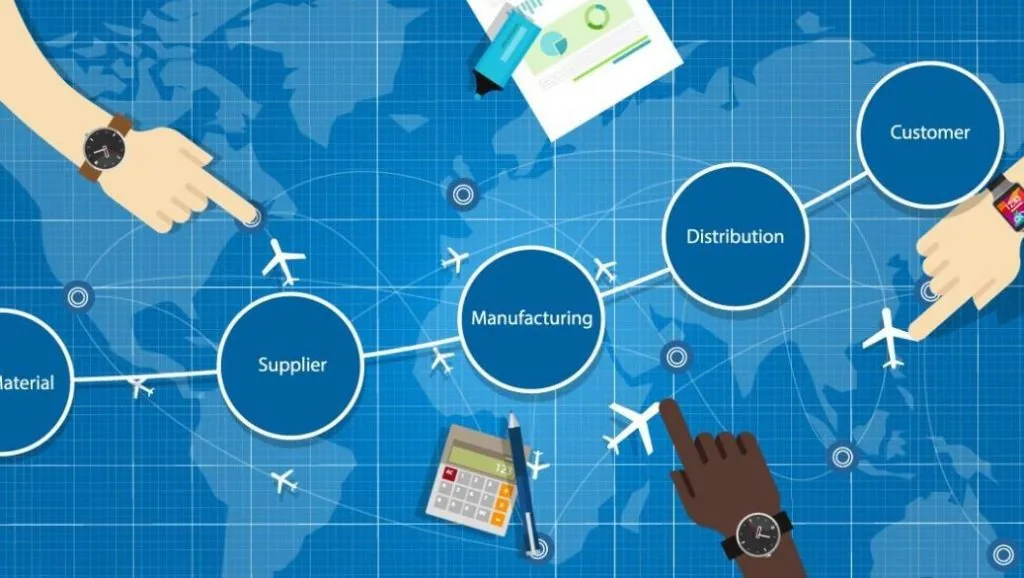
Domestic vs global supply chain
| Domestic (made and sold in one country) | Global (made in China, sold abroad) | |
|---|---|---|
| Unit cost | Usually higher | Usually lower, especially for labor-heavy products |
| Product range and customization | Narrower | Very wide; industrial clusters for almost every category |
| Lead time to restock | Days to weeks | Weeks to months, longer around Chinese New Year |
| Cash tied up | Less, for a shorter time | More, for longer |
| Exposure to tariffs and customs rules | Low | High |
| Delivery speed to customers | Fast | Depends on the shipping line; fast once stock sits in an overseas warehouse |
Many stores end up with a hybrid: production in China, bestsellers stocked in the destination country, and the long tail shipped straight from China. Our guide to combining fulfillment setups shows how the pieces fit.
What changed in 2025–2026
- No more duty-free parcels. The US $800 de minimis exemption ended for China and Hong Kong in May 2025 and for every country in August 2025. In June 2026 US Customs made the suspension indefinite, and the law repeals it permanently from July 1, 2027. Every parcel from China now owes US duty.
- Tariffs keep moving. In February 2026 the US Supreme Court struck down the tariffs imposed under the International Emergency Economic Powers Act (IEEPA). A temporary 10% global tariff replaced them until July 24, 2026. Since that date, most Chinese goods carry a new 12.5% Section 301 duty, on top of the older Section 301 duties that already applied to many products. Treat the duty rate as a variable: check it for each product's HS code before every order, not once a year.
- The holiday calendar still rules production. Chinese New Year falls on February 6, 2027. Factories slow down for weeks around it, not just for the official days off, and the government normally publishes the exact holiday schedule only a few months ahead. Our seasonal inventory guide shows how to plan stock around it.
A resilience checklist for a small global supply chain
- Know your landed cost per SKU. Product, sourcing fee, freight, duty and fulfillment per order. Re-run it whenever the duty rate changes. Our profit margin guide shows the math.
- Declare true values and the right HS code. Under-declaring saves a little duty and risks a lot: held goods, penalties and an importer record that customs will scrutinize from then on.
- Keep a second supplier for your top sellers. An approved sample and a price on file means a factory problem costs you days, not months.
- Bring suppliers together in one warehouse. One receiving point gives you one inspection standard and one parcel per order instead of one per supplier.
- Build buffers before known gaps. Chinese New Year, China's National Day week in early October and the US holiday peak are on the calendar every year.
- Split stock by speed. Hold the long tail in China and move steady sellers to a warehouse in the destination country. See how a global warehouse network works.
- Ship duties paid. If the duty isn't prepaid, the carrier can bill your customer before delivery, and many refuse the parcel.
- Keep paperwork for every shipment. Commercial invoice, packing list, proof of payment. Customs questions can come months later.
How PackQuay fits in your chain
We run the China end of the chain from our own warehouse in Xinxiang, Henan: sourcing from factories, receiving and inspecting goods (20% of each batch checked free), storage (free for the first 2 months) and branded packing. From there, orders go out on 30+ shipping lines, and bestsellers can sit in one of our 18+ overseas warehouses for 1–5 day delivery. Message an account manager on WhatsApp with your products and target markets, and we'll map the chain with you.
FAQ
What is a global supply chain in simple terms?
It is the network of suppliers, factories, warehouses, carriers and sellers that makes and delivers a product when those parties sit in different countries. Goods, information and money all cross borders along the way.
What is an example of a global supply chain?
A phone case designed by a US store owner, made in a Chinese factory from materials bought in China, inspected and packed in a warehouse in China, shipped by air, cleared through US customs with duties paid, and delivered by a US carrier.
What are the biggest risks in a global supply chain?
Long and variable lead times, factory holidays such as Chinese New Year, quality problems found too late, freight delays in peak season, and changes in tariffs and customs rules. Buffers, inspection before shipping and a second supplier reduce most of them.
Do I pay US duties on products from China in 2026?
Yes. The $800 de minimis exemption no longer applies, so every parcel owes duty. Since July 24, 2026, most Chinese goods also carry a 12.5% Section 301 duty on top of any other duties that apply to the product, so check the rate for your HS code before each order.
Is a global supply chain worth it for a small online store?
Usually yes for products where China's factory prices and range give you a real margin advantage, as long as you price on landed cost and plan around the longer lead times. Products that are heavy, cheap to make locally or need very fast restocks can be better sourced closer to your customers.