
What Is a Multi-Vendor Marketplace? How It Works in 2026
Quick answer: A multi-vendor marketplace is a website or app where many independent sellers, called vendors, list and sell their own products under one storefront, while one company, the operator, runs the site, the checkout and the rules. The operator takes a commission or fee from each sale; vendors look after their own stock and usually their own shipping. Amazon, eBay, Etsy and Walmart Marketplace all work this way. In the US, running one also brings legal duties: collecting sales tax under marketplace facilitator laws in every state with a statewide sales tax, and verifying high-volume sellers under the INFORM Consumers Act.
Who does what in a marketplace
Three parties meet on every marketplace: the operator, the vendors and the buyers. A payment provider usually sits between them. The split of work looks like this:
| Task | Usually handled by | Notes |
|---|---|---|
| Website, search, checkout | Operator | One shopping cart across all vendors |
| Listings and prices | Vendor | Inside the operator's category and content rules |
| Holding stock | Vendor | Some operators also rent warehouse space to vendors |
| Packing and shipping | Vendor, or the operator's fulfillment program | Delivery speed is usually measured per vendor |
| Taking payment | Operator, through its payment provider | Vendors are paid later, minus fees |
| Customer questions | Vendor first | The operator steps in on disputes |
| Returns | Vendor, under the operator's return policy | The operator sets the minimum standard |
| US sales tax on marketplace sales | Operator | Under state marketplace facilitator laws |
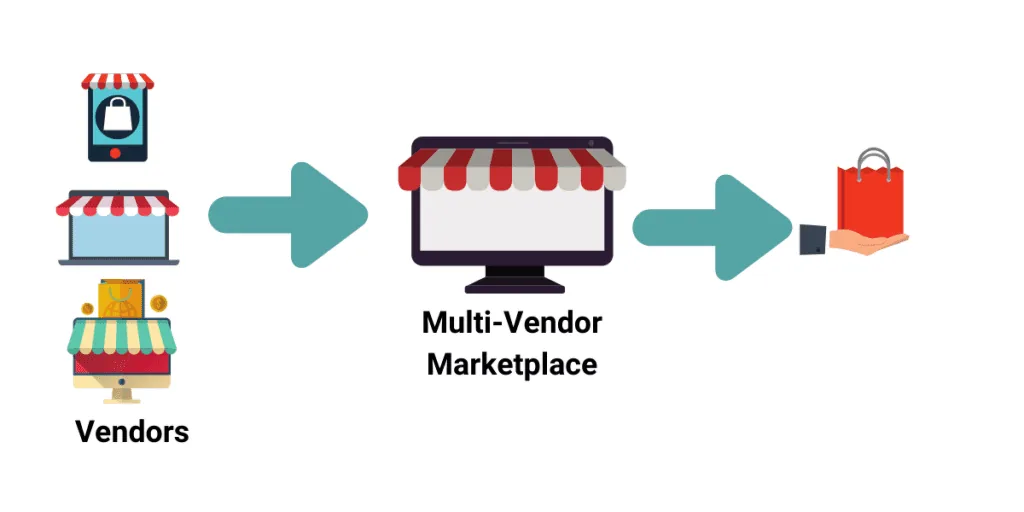
How one order moves through a marketplace
- One cart, several sellers. A shopper adds a lamp from vendor A, a rug from vendor B and cushions from vendor C.
- One checkout, one payment. The operator's payment provider takes the full amount.
- The order splits. Each vendor sees only its own lines, as a separate sub-order.
- Each vendor ships its part. The shopper may get three parcels on three different days, each with its own tracking number.
- Money is divided. On the operator's settlement schedule, each vendor is paid its share after the commission and any other fees are deducted.
- Problems go back to the seller who shipped. A missing cushion is vendor C's case to solve, with the operator as referee if the shopper and vendor disagree.
Step 5 is the technical heart of the model. In an ordinary online store, all the money lands in a single merchant account. A marketplace needs a payment setup built for split payouts, where one charge is shared between several sellers and the operator's cut comes off first. Step 4 is the weak spot for shoppers: several parcels per order, and several return processes, is the price of a wide range.
How marketplaces make money
| Model | How it works | Where you see it |
|---|---|---|
| Commission | A percentage of each sale | Most product marketplaces |
| Listing fee | A charge per item listed or renewed | Handmade and secondhand marketplaces |
| Seller subscription | A monthly fee to sell, or to unlock a better tier | Niche and professional marketplaces |
| Advertising | Vendors pay for sponsored placement in search | Large marketplaces with heavy traffic |
| Services | Storage, shipping, payments or financing sold to vendors | Marketplaces that run their own logistics |
Most large marketplaces stack several of these. For a vendor, that means the headline commission is rarely the full cost of selling there.
Types of multi-vendor marketplace
- By who trades: business to consumer, business to business, or consumer to consumer. Wholesale platforms are the B2B version of the same model; see what an online B2B marketplace is.
- By range: horizontal marketplaces sell almost everything; vertical ones focus on one niche, such as crafts, furniture or electronics parts.
- By what changes hands: physical products, services, rentals or digital goods. Each needs different rules for delivery, refunds and disputes.
Rules an operator takes on in the US (2026)
- Sales tax. All 45 states with a statewide sales tax, plus Washington, D.C., have marketplace facilitator laws. Once a marketplace passes a state's threshold, it must collect and remit sales tax on the sales it facilitates for its vendors. Thresholds differ; many states use $100,000 in sales.
- Seller verification. The INFORM Consumers Act, in force since June 27, 2023, requires online marketplaces to collect and verify bank account, tax ID, government ID and contact details from high-volume third-party sellers: those with 200 or more sales and $5,000 or more in gross revenue in any continuous 12-month period during the previous 24 months. Sellers who don't provide or certify the information must be suspended, and sellers above $20,000 a year must have their name and contact details shown to buyers.
- Payments. Collecting money for other sellers needs a payment provider that supports that model. Shopify's terms, for example, state that its services are not a marketplace and bar merchants from using Shopify Payments as a payment intermediary or aggregator for third parties.
This is a summary, not legal or tax advice. Check state rules with a tax adviser before launching.
Selling on a marketplace vs running one
For most product sellers, the real question isn't whether to build a marketplace. It's whether to become a vendor on someone else's. A vendor borrows the operator's shoppers and pays for them through fees and rules. An operator has to attract both sides at once: shoppers won't come without sellers, and sellers won't join without shoppers. If you are weighing the two, our comparison of single-vendor and multi-vendor stores walks through the decision, and dropshipping vs marketplace covers selling on one while a partner ships for you.
If you're a vendor whose products ship from China
- Read the handling-time rule first. Pick a shipping line that meets the marketplace's targets with room to spare, not on a good day.
- Be the only seller on the parcel. Marketplaces expect your business, not your supplier, to appear on anything inside the box.
- Price on landed cost. Product, shipping, US duties and the fulfillment fee, then the marketplace's fees on top. Every parcel from China now pays US duties, whatever its value.
- Keep one stock count. If you sell the same units on a marketplace and in your own store, overselling leads to cancellations, and cancellations hurt your seller rating.
- Move steady sellers closer to buyers. Stock in a warehouse in the buyer's country makes fast-delivery targets realistic.
How PackQuay helps
If you sell on marketplaces and source from China, PackQuay is the team on the ground. We buy from the factory, inspect 20% of every batch free, store your stock in our own Xinxiang warehouse (free for the first 2 months, and free while you have orders to process) and pack each order under your brand. Message us on WhatsApp and we connect your Shopify or WooCommerce store for you. Orders come in automatically, and tracking numbers go back to your store once parcels ship. Marketplace orders can be sent as a CSV or Excel file. Stocked orders leave within 24 hours, 48 at peak, and best sellers can move to our overseas 3PL warehouses for 1–5 day delivery. Ask your account manager on WhatsApp.
FAQ
What is a multi-vendor marketplace in simple terms?
An online mall. One company runs the website and the checkout, and many independent sellers list their own products in it. The operator takes a fee on each sale, and the sellers handle their own stock and shipping.
Which well-known sites are multi-vendor marketplaces?
Amazon, eBay, Etsy and Walmart Marketplace for consumer goods. Wholesale platforms such as Alibaba.com apply the same model to business buyers.
How do payments work on a multi-vendor marketplace?
The shopper pays once and the operator's payment provider collects the money. Each vendor is then paid its share on the operator's schedule, after commission and fees are deducted, which needs a payment setup designed for split payouts.
Who collects sales tax on marketplace sales in the US?
The marketplace, under marketplace facilitator laws in every state with a statewide sales tax, once it passes that state's threshold. Sellers still handle sales tax on orders through their own websites.
What does the INFORM Consumers Act require?
Since June 2023, online marketplaces must collect and verify identity, bank, tax and contact details from high-volume third-party sellers, meaning 200 or more sales and $5,000 or more in a 12-month period, and suspend sellers who don't provide them.