
Single Vendor vs Multi-Vendor Store: Which to Build in 2026
Quick answer: A single-vendor store sells one business's products, and that business controls the catalog, prices, stock, shipping and customer service. A multi-vendor store, usually called a marketplace, lets many independent sellers list in one storefront while the owner runs the site and takes a commission. A single-vendor store is quicker to launch, simpler to run and keeps quality in your hands. A marketplace offers a wide range without buying stock, but you must recruit sellers and buyers at the same time and take on split payments, seller vetting and, in the US, marketplace tax and seller-verification duties. Most dropshippers are best served by a hybrid: one brand in front, several factories behind it, consolidated by one fulfillment partner.
"Vendor" has a second meaning in purchasing: buying from one supplier or several. That is a sourcing-strategy question, covered in our guide to single vs multiple sources. This article is about the store model.
The two models side by side
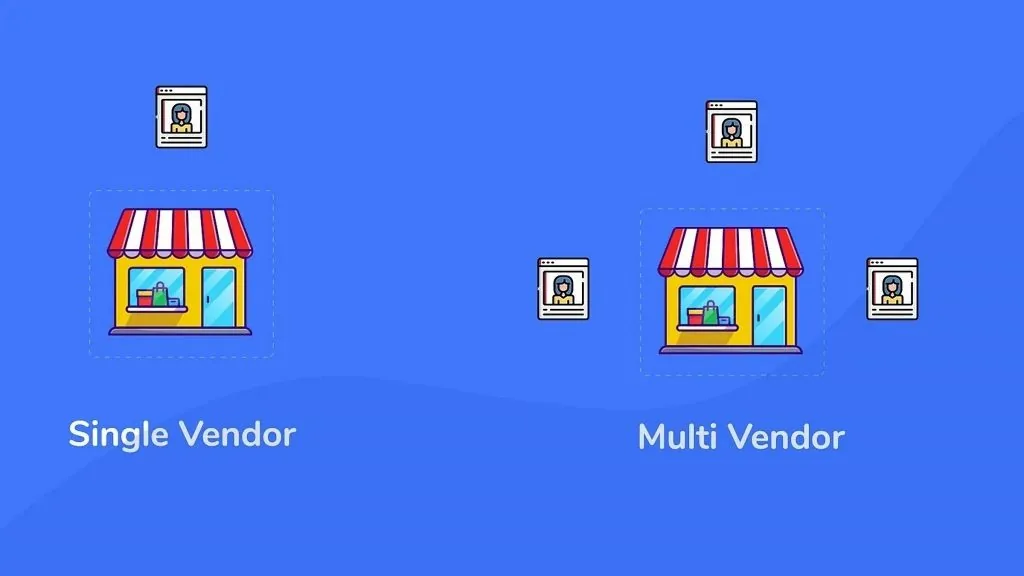
| Factor | Single-vendor store | Multi-vendor marketplace |
|---|---|---|
| Who sells | You | Many independent sellers |
| How you earn | Margin on each product | Commission, listing or subscription fees |
| Catalog | You choose every product | Sellers choose, inside your rules |
| Quality control | You check the stock | Each seller's job; you police it with ratings and removals |
| Launch effort | Lower: a standard store platform works | Higher: seller onboarding, payouts, moderation, dispute tools |
| Payments | One merchant account | Split payouts to many sellers |
| Shopper experience | One parcel and one return policy per order | Possibly several parcels and policies per order |
| Biggest risk | Wrong products, stock you can't sell | The empty-room problem: no buyers without sellers, and the reverse |
| US legal duties | Sales tax where your business has nexus | Also marketplace facilitator tax collection and INFORM Act seller checks |
When a single-vendor store is the right call
- You are selling your own products, or products you choose and stand behind.
- Brand matters to you: packaging, insert cards and one consistent customer experience.
- You want to start selling this month, not after recruiting a seller base.
- Your margin comes from the product, not from taking a cut of other people's sales.
Almost every Shopify or WooCommerce dropshipping store is single-vendor, even when the products come from many factories.
When a multi-vendor marketplace makes sense
- You can reach a supply side others can't easily reach, such as a community of makers, local sellers or a trade network.
- The niche is fragmented: many small sellers, no dominant store, and buyers who want to compare.
- You can fund both sides of the launch, often subsidizing sellers or shoppers early on.
- You are ready to run trust and safety: vetting sellers, removing bad listings and settling disputes every day.
What a marketplace adds to your workload
- Seller onboarding. Applications, identity checks and agreements. In the US, the INFORM Consumers Act requires marketplaces to collect and verify bank, tax ID, ID and contact details from sellers with 200 or more sales and $5,000 or more in revenue over 12 months.
- Listing moderation. Prohibited items, fake claims, copied photos and counterfeit brands all become your problem.
- Split payouts. One checkout, many payees, commission deducted, refunds clawed back from the right seller.
- Sales tax. Every state with a statewide sales tax, plus D.C., has a marketplace facilitator law that makes a qualifying marketplace collect tax on its sellers' sales.
- Performance policing. Late shipments and unanswered messages from one seller hurt your whole site's reputation.
A platform reality check
The two most common store platforms are single-vendor at heart. Shopify's terms state that its services are not a marketplace and that the store owner is the seller of record for every sale, and its payment terms bar merchants from acting as a payment intermediary or aggregator for third parties. WooCommerce is a single-store plugin too. Both can be turned into marketplaces with third-party add-ons for vendor accounts, commissions and payouts, but the payment side needs care: pick a payment provider that explicitly supports marketplaces, and confirm your model with it in writing. Our guide to what "Shopify marketplace" means covers the Shopify side in more detail.
The hybrid most dropshippers run
There is a middle path that gives you a marketplace's range without a marketplace's workload: a single-vendor storefront with several suppliers behind it.
- In front: one brand, one checkout, one return policy, one customer service voice.
- Behind: several factories, each making what it is best at.
- In the middle: one fulfillment partner that buys from each factory, checks the goods, stores them in one place and packs each order as a single parcel.
Take an order for a phone case from factory A, a charger from factory B and a cable from factory C. In a marketplace, that is three sellers, three parcels and three tracking numbers. In the hybrid, it is one parcel in your packaging. At PackQuay's published rates, packing that three-SKU order on a day with 1–19 orders costs $2.00 for the order plus $1.00 for each additional SKU: $4.00 in total. On busier days the rates step down; the full table is on our pricing page.
The trade-off is that you own the product decisions. If factory B's chargers start failing, your store takes the reviews. That is why inspection on arrival matters more in this model; see how our product inspection works.
Six questions to decide
- Do I want to earn from products or from fees on other people's products?
- Can I attract sellers and shoppers at the same time, or only shoppers?
- Am I ready to vet sellers, moderate listings and settle disputes every week?
- Does my payment provider support split payouts for my business model?
- How much does one consistent unboxing and return policy matter to my brand?
- Could a single store with several suppliers behind it give me the range I want?
If you answered "products" to the first question and "yes" to the last, build a single-vendor store. For the bigger picture of how marketplaces work, see what a multi-vendor marketplace is.
How PackQuay helps
PackQuay is built for the hybrid model. We source from several factories, inspect 20% of every batch free, hold the stock in our own warehouse in Xinxiang and pack items from different suppliers into one branded parcel. Message us on WhatsApp and we connect your Shopify or WooCommerce store for you. Orders come in automatically, and tracking numbers go back to your store once parcels ship. You can also send orders as a CSV or Excel file. No subscription, no monthly fee. Send your product links to your account manager on WhatsApp, Monday to Saturday, 9:00–18:00 Beijing time.
FAQ
What is the difference between single vendor and multi-vendor?
A single-vendor store sells one business's products and that business controls everything from stock to customer service. A multi-vendor store, or marketplace, lets many independent sellers list in one storefront while the owner runs the site and earns fees.
Is Shopify single-vendor or multi-vendor?
Single-vendor by design. Shopify's terms say its services are not a marketplace and the store owner is the seller of record. Multi-vendor setups on Shopify rely on third-party apps, and the payment side needs careful setup.
Is a multi-vendor marketplace more profitable than a single store?
It can grow without buying stock, but the fee per order is small and you carry the cost of recruiting sellers and buyers, moderation and payouts. Most small sellers reach profit sooner with a single-vendor store.
Can a single-vendor store sell products from several suppliers?
Yes. That is how most dropshipping stores work: one brand in front, several factories behind it, with a fulfillment partner combining items into one parcel per order.
What does single vendor mean in purchasing?
Buying a product or service category from one supplier only. It simplifies management and can bring volume discounts, but it creates dependence on that supplier, so many sellers add a backup source for best sellers.