
What Is an Online B2B Marketplace? How Buying Works (2026)
Quick answer: An online B2B marketplace is a platform where many businesses sell to other businesses, usually in bulk. Manufacturers, trading companies and wholesalers list products; business buyers compare them, request quotes and place orders. Unlike a consumer marketplace, prices depend on quantity, most listings carry a minimum order quantity (MOQ), and samples, customization, delivery terms and payment are agreed deal by deal. For an online store, a B2B marketplace is where you find the factory and the volume price. It is not a fulfillment service: suppliers sell by the carton and won't pack single orders to your customers under your brand.
B2B marketplace vs B2C marketplace vs a supplier's own trade site
| B2B marketplace | B2C marketplace | A supplier's own B2B site | |
|---|---|---|---|
| Sellers | Many businesses | Many sellers | One company |
| Buyers | Businesses | Consumers | That company's trade accounts |
| Price | Tiered by quantity, often negotiated | A fixed retail price | Price lists, often after account approval |
| Minimum order | Common | Rare | Common |
| How you buy | Inquiry or quote first; some listings allow direct orders | Add to cart and pay | Log in, request a quote, pay an invoice |
| Delivery | Terms agreed per deal | Seller ships to the shopper | Per contract |
| Best for | Comparing many suppliers at once | Buying finished goods one at a time | Reordering from a supplier you already trust |
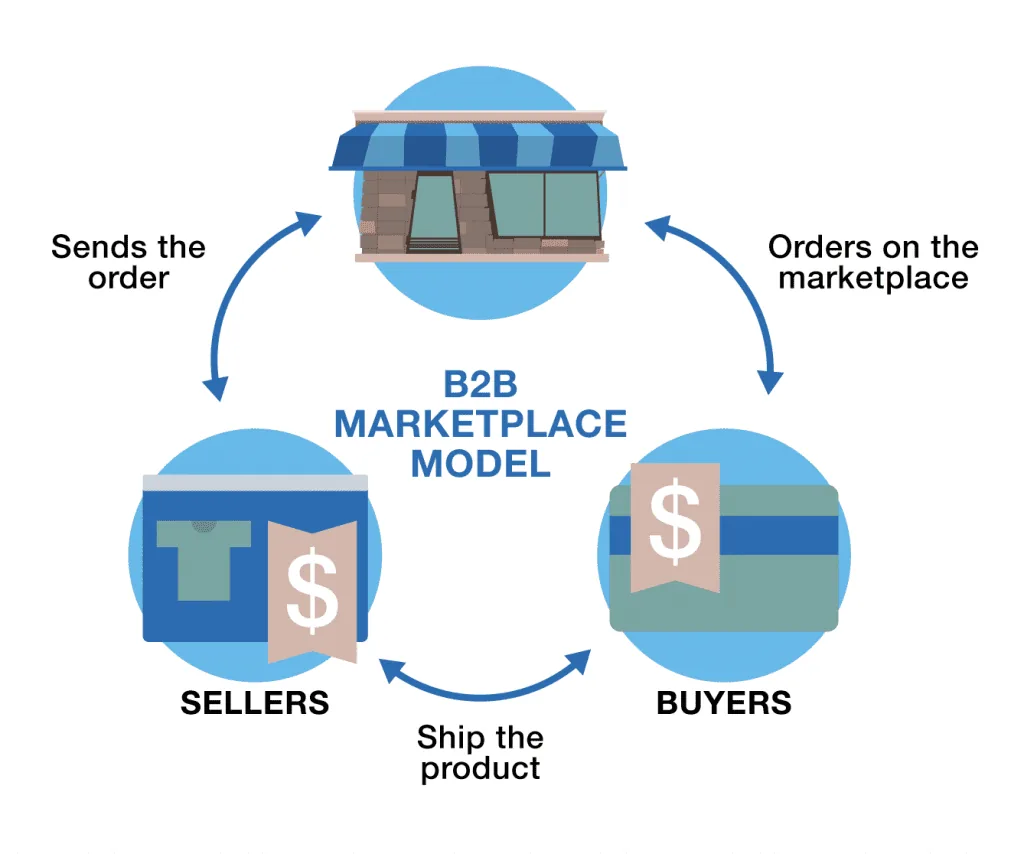
The main kinds of B2B marketplace
- Global export platforms. Suppliers, many of them in China, selling to overseas buyers in English. Alibaba.com is the best-known example.
- Domestic wholesale platforms. China's internal trade sites, such as 1688, list the lowest prices but work in Chinese, take Chinese payment methods and usually deliver only inside China. Our 1688 guide explains how overseas sellers buy there.
- Vertical marketplaces. One industry only: electronic components, packaging, textiles, industrial parts.
- Procurement networks. Large companies' purchasing departments buying from approved suppliers. Rarely relevant to a small online store.
If you want to know which platform suits which product, we compare the big ones in B2B marketplaces for dropshippers. The rest of this guide is about how buying on any of them works.
How a purchase works, step by step
- Search and shortlist. An image search with a product photo usually beats keywords. Shortlist suppliers that show production details, materials and options, not only stock photos.
- Send a request for quotation (RFQ). Send the same brief to three to five suppliers: quantity, material, size, color, packaging, logo, and the country you ship to. Identical briefs make quotes comparable.
- Read the quote properly. Look for the unit price at your quantity, the MOQ, the price tiers, the production lead time, the packed carton size and weight, and the delivery term.
- Order samples. Approve one, photograph it and keep it. It becomes the reference every later batch is checked against.
- Agree the terms. Delivery term, payment schedule, inspection before shipment, and what happens if goods fail it.
- Pay through a protected route where you can. Platform payment protection generally applies only to orders placed and paid on the platform. Money wired outside it loses that cover.
- Production and inspection. Check the goods against the approved sample before they leave the factory, or when they reach your warehouse.
- Freight and customs. Who books shipping, who clears customs and who pays import duties depends on the delivery term you agreed.
Terms you'll meet on every B2B platform
| Term | What it means | Why it matters to a small seller |
|---|---|---|
| MOQ | Minimum order quantity | Often negotiable for stock items; firm for custom work |
| RFQ | Request for quotation | A clear brief gets faster, comparable answers |
| Price tiers | Unit price falls at set quantities | Quote at the quantity you will really buy |
| Lead time | Days from deposit to goods ready | Plan reorders around it, plus transit |
| OEM | The factory makes your design | You own the design work and tooling decisions |
| ODM | The factory's existing design, with your changes or branding | Faster and cheaper than OEM, less unique |
| EXW | Ex Works: you collect from the seller's premises | Lowest quote, but every cost after the factory door is yours |
| FOB | Free On Board: seller delivers onto the vessel at the named port | Common for sea freight; you pay the ocean leg and import |
| DDP | Delivered Duty Paid: seller delivers with import duties paid | Simplest for you, but check what is built into the price |
EXW, FOB and DDP are three of the eleven Incoterms 2020 rules published by the International Chamber of Commerce. Incoterms 2020 is still the edition in force in 2026; the ICC has started work on the next revision, currently planned for late 2029. Write the edition next to the term in any purchase order, for example "FOB Shenzhen, Incoterms 2020".
What a B2B marketplace won't do for an online store
- Hold your stock between orders.
- Pack and ship one order at a time to a consumer.
- Put your brand on the parcel or slip in your insert card.
- Send tracking numbers back for each of your customers' orders.
- Combine items from three different suppliers into one parcel.
- Check quality on your behalf before goods reach your customer.
That gap is why most stores pair a B2B marketplace with a buying agent or fulfillment partner in China. The marketplace finds the factory; the partner buys, checks, stores and ships. For who's who in that chain, see wholesaler vs distributor vs supplier.
What buying through an agent costs: two examples
Suppose you have found a supplier and want an $8,000 first batch (an example figure). Through PackQuay, the sourcing fee is a published percentage of product cost: $8,000 falls in the 9% tier ($5,001–$10,000), so the fee is $720. A later $60,000 reorder falls in the 6% tier ($50,001–$100,000): $3,600. Adding your logo or private-label packaging adds 2.5%. For that, the buying is done in Chinese, paid in RMB, received at our own warehouse and checked on arrival. Full tiers are on our pricing page.
How PackQuay helps
Send us the links you found on any B2B marketplace, or just a photo. Our buyers confirm the factory, price and stock, place the order and receive it at our warehouse in Xinxiang, where 20% of every batch is inspected free and storage is free for the first 2 months. For your store's orders, message us on WhatsApp and we connect your Shopify or WooCommerce store for you. Orders come in automatically, and tracking numbers go back to your store once parcels ship. You can also send orders as a CSV or Excel file. See our product sourcing service or message us on WhatsApp.
FAQ
What is an online B2B marketplace?
A platform where many businesses sell to other businesses, usually in bulk. Manufacturers, trading companies and wholesalers list products, and business buyers compare suppliers, request quotes and order at volume prices.
How is a B2B marketplace different from a B2C marketplace?
On a B2B marketplace prices fall with quantity, most listings have a minimum order, and terms such as samples, delivery and payment are negotiated. A B2C marketplace sells single items to consumers at a fixed price.
Is Alibaba a B2B marketplace?
Yes. Alibaba.com connects overseas business buyers with suppliers, mainly in China, and supports inquiries, quotes and bulk orders. 1688 is Alibaba Group's wholesale site for buyers inside China.
What does MOQ mean when buying wholesale?
Minimum order quantity: the smallest order a supplier will accept for an item. For stock items it is often negotiable; for custom colors, logos or packaging it is usually firm because of setup costs.
Can I dropship directly from a B2B marketplace?
Rarely. Most suppliers sell by the carton and won't ship single parcels under your brand. The usual route is to buy a small batch into a fulfillment warehouse in China that then ships each order to your customers.