
What Is Ecommerce Dropshipping? Definition, How It Works, Costs
Quick answer: Ecommerce dropshipping is an online retail model in which the seller never stocks the goods. A customer buys from your store; you then order the item from a supplier, who delivers it directly to that customer. You own the storefront, pricing, marketing and customer care. The supplier owns the inventory, packing and shipping. Startup cash is low, but each unit costs more than buying in bulk, and quality and delivery speed sit in your supplier's hands. In 2026 there's one more cost to plan for: every parcel shipped from China to the US now pays import duty.
How one dropshipped order works
- The customer orders in your store and pays your retail price.
- You pass the order to your supplier, by hand, by file or through an integration, and pay the supplier's price plus shipping.
- The supplier picks, packs and ships the item to your customer's address.
- The tracking number comes back to you, and you send it to the customer.
- Your profit is what the customer paid minus everything the order cost you.
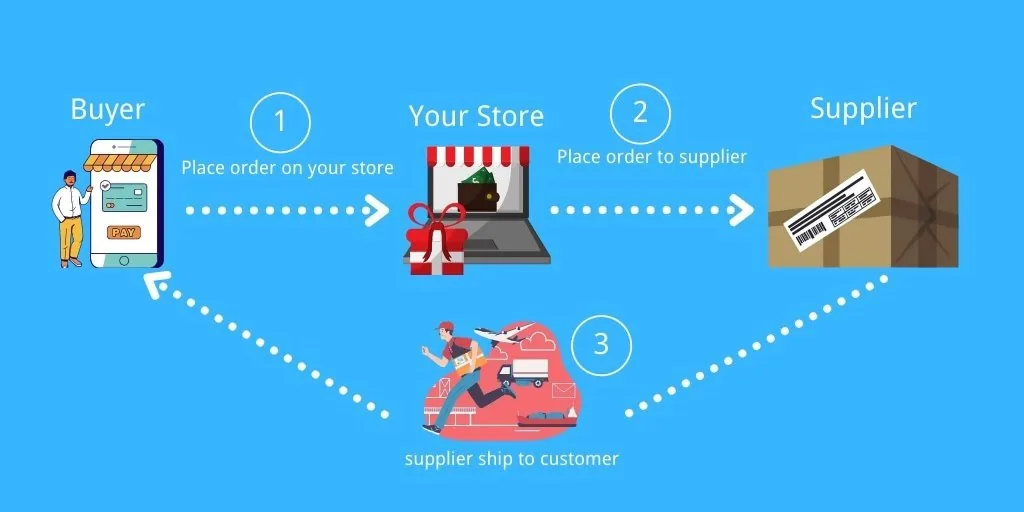
The customer sees one seller: you. That's why the customer service, the returns policy and the reviews are all yours, even though you never touch the product. Our map of the dropshipping supply chain shows who is responsible for each step between the factory and the customer.
Dropshipping vs. other ways to sell online
| Model | Who holds stock | Cash needed upfront | Unit cost | Delivery speed |
|---|---|---|---|---|
| Dropshipping | The supplier | Lowest | Highest | Slowest; each item is bought after the order |
| Stocked fulfillment (3PL) | You, in someone else's warehouse | Medium | Lower, bought in batches | Fast; ships from stock |
| Self-fulfillment | You, at home or in your own space | Medium | Lower | Depends on you |
| Print on demand | Nobody; made per order | Lowest | High | Production time plus shipping |
| Marketplace fulfillment (e.g. Amazon FBA) | You, in the marketplace's warehouse | Medium to high | Lower | Fast within that marketplace |
These aren't either-or choices. Many stores start with dropshipping to test products and move proven sellers to stocked fulfillment. Our comparison of dropshipping vs. ecommerce fulfillment explains when to switch. You may also come across reverse dropshipping, which runs the other way: sourcing in Western markets and selling into China and other Asian markets.
Who the supplier can be
- Marketplace sellers, such as sellers on AliExpress. Easy to start with, but you pay retail prices and get their packaging.
- Wholesalers with a dropship program, often in your own country. Faster delivery, higher prices, little room for branding.
- A dropshipping agent in China that buys from factories and ships from its own warehouse. Factory prices, inspection and your own branding, once you have steady orders.
Our guide to dropshipping suppliers covers every type and how to vet them.
What one order costs in 2026
Product price is only part of the cost. What matters is landed cost: everything it takes to get the order to your customer's door with duties paid. Parcels worth under $800 used to enter the US duty-free, but that ended for China and Hong Kong in May 2025 and for all countries in August 2025. US Customs made the suspension indefinite in June 2026, and the law repeals the exemption permanently from July 1, 2027.
A worked example. The sourcing fee and pick and pack are PackQuay's published rates (a batch under $5,000, a day with fewer than 20 orders); lines marked "example" are assumptions for illustration, not quotes.
| Line | Amount |
|---|---|
| Product (example) | $6.00 |
| Sourcing fee, 10% | $0.60 |
| Pick and pack | $2.00 |
| Mailer (example) | $0.15 |
| Shipping on a duties-paid line (example) | $5.20 |
| US duty (example) | $1.10 |
| Landed cost | $15.05 |
| Selling price (example) | $34.99 |
| Gross profit | $19.94 (57%) |
Advertising, payment fees and refunds still come out of that $19.94. Our guide to a good dropshipping profit margin works through the rest.
Pros and cons
What works in its favor
- No stock to buy before you know a product sells.
- You can test many products quickly and drop the losers.
- You can run the store from anywhere.
- Your time goes into marketing and customers, not packing.
What works against it
- Higher unit costs, so thinner margins than buying in bulk.
- Slower delivery, especially when each item is bought after the order.
- Quality is only as good as your supplier's checks.
- Successful products are easy for others to copy.
- Duties on every US parcel from China, which must be priced in.
Is dropshipping legal?
Yes. Selling goods that a third party ships is an ordinary retail arrangement. Stores get into trouble because of how they do it, not because of the model:
- Selling products that break safety or labeling rules in the customer's country. You are the seller, so it's your problem.
- Promising delivery times you can't meet. In the US, the FTC requires a reasonable basis for any shipping time you advertise.
- Breaking a marketplace's own dropshipping policy. Amazon, for example, sets conditions on who must appear as the seller; see our guide to dropshipping on Amazon.
Is dropshipping right for you?
It suits you if most of these are true:
- You'd rather risk ad budget than money tied up in stock.
- You're comfortable with marketing; that's where most of the work is.
- Your products are light, sturdy and easy to ship.
- Your customers accept delivery times longer than next-day.
- You're willing to switch to stock once a product proves itself.
If you need next-day delivery or want to sell heavy, fragile or regulated products, plan on holding stock closer to your customers from the start.
How to start, in six steps
- Pick a niche you can reach and that isn't high-risk on compliance. See how to choose a niche.
- Choose products with room for landed cost and ads.
- Find a supplier and place test orders to your own address.
- Build the store on a platform such as Shopify or WooCommerce, with clear shipping, duties and returns pages.
- Test with a small ad budget and set kill rules before you start.
- Hold stock of what sells and keep dropshipping the rest.
How PackQuay fits in
PackQuay is a dropshipping agent with its own warehouse in Xinxiang, China. We source from factories, inspect 20% of every batch free, and ship each order under your brand, with multi-item orders combined into one parcel. Orders without stock are purchased in an average of 4–5 days after payment; stocked orders ship within 24 hours (48 at peak). There's no subscription. Message us on WhatsApp and we connect your Shopify or WooCommerce store for you. Orders come in automatically, and tracking numbers go back to your store once parcels ship. You can also send orders as a CSV or Excel file. Send a product link for a landed-cost quote, or see our dropshipping agent service.
FAQ
What is ecommerce dropshipping in simple terms?
Selling products online that you don't keep in stock. When a customer orders, you buy the item from a supplier, who ships it directly to the customer; your profit is what's left after paying the supplier and the other order costs.
How do dropshippers make money?
From the gap between the retail price the customer pays and the landed cost of the order, which includes the product, shipping, duties and fulfillment fees. Advertising, payment fees and refunds come out of that gap too.
Is dropshipping still worth it in 2026?
It can be, if you price on landed cost. Every US parcel from China now pays import duty, so margins worked out on product price alone overstate profit. It works best as a way to test products before holding stock of the winners.
How long does a dropshipped order from China take to arrive?
It depends on the shipping line and on whether the item is in stock. At PackQuay, stocked orders leave within 24 hours (48 at peak), while unstocked items take an average of 4–5 days to purchase first; transit time then depends on the line. Stock held in an overseas warehouse delivers in 1–5 days.
What is the difference between dropshipping and ecommerce?
Ecommerce covers all online selling. Dropshipping is one ecommerce model, where the seller doesn't hold stock and a supplier ships each order directly to the customer.