
What Is Order Management? OMS Explained for Small Online Sellers
Quick answer: Order management is everything that happens to an order as a record, from checkout to the last refund: capturing it, checking payment and stock, deciding where it ships from, passing it to whoever packs it, keeping the customer informed, and handling changes, cancellations and returns. An order management system (OMS) is software that does all of this in one place, across every channel you sell on. If you sell through one store with one fulfillment partner, your store's admin already is your OMS. A separate system starts to earn its cost when the same stock sells on several channels, or sits in more than one location.
The order management lifecycle
Every order passes through the same jobs, whatever software runs them:
| Stage | What happens | Who does it in a small store |
|---|---|---|
| 1. Capture | The order is recorded with items, prices, customer and address | Store platform |
| 2. Validate | Payment confirmed, fraud risk checked, address checked | Store platform and payment provider; you review flagged orders |
| 3. Allocate | Stock is reserved so the item can't be sold twice | Store platform, using stock counts from your warehouse |
| 4. Route | The order is assigned to the location that will ship it | Automatic with one location; routing rules with several |
| 5. Release to fulfillment | The order goes to the warehouse, 3PL or agent | Integration with your fulfillment partner |
| 6. Notify | Confirmation, shipping and delivery messages to the customer | Store platform, triggered by tracking |
| 7. Change and cancel | Address edits, swaps, cancellations before dispatch | You, passed on to the partner |
| 8. Returns and refunds | Return approval, refund, restock or write-off | You, with your partner for physical returns |
| 9. Report | Sales, cost per order, late orders, problem SKUs | Store reports plus your partner's invoices |
Notice that a small store already has a tool for every row. The question is never "do I have order management?" but "does my current setup still do these nine jobs without someone copying data by hand?"
OMS vs WMS vs inventory software vs ERP
Software vendors blur these, so it helps to anchor each one to the single question it answers:
| System | The question it answers | Data it owns | What a small seller usually uses |
|---|---|---|---|
| OMS (order management system) | What was ordered, and where is that order now? | Orders, customers, order status | The store admin (Shopify, WooCommerce) or a marketplace's order page |
| WMS (warehouse management system) | Which shelf holds it, and who packs it next? | Shelf locations, pick lists, physical stock | The fulfillment partner's own system |
| Inventory management | How many do we have, everywhere, and when do we reorder? | Stock counts per SKU and location, reorder points | Store stock counts fed by the partner; a spreadsheet for reorders |
| ERP | How does the whole business add up? | Purchasing, finance, production, plus all of the above | Usually none until the business is much larger |
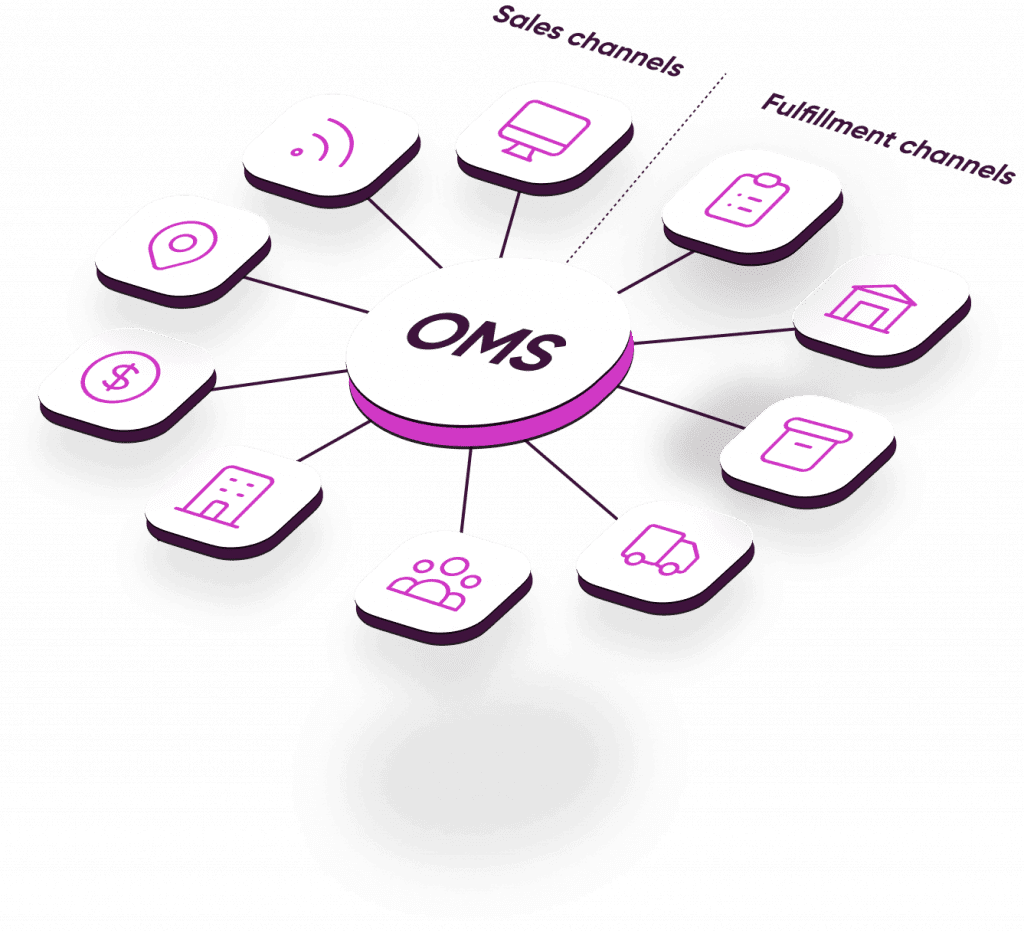
A dedicated OMS sits on top of your channels and below your ERP. It takes in orders from every channel, holds one stock picture, applies routing rules and sends each order to the right warehouse. The routing part on its own has a name, distributed order management, which we cover in routing orders between China and overseas warehouses.
Do you need a separate OMS?
Run down this list. Each "yes" is a reason; three or more usually means it's time.
- You sell the same products on three or more channels, such as your own store, Amazon and TikTok Shop, and you've oversold at least once.
- Your stock sits in two or more locations, such as a China warehouse and an overseas one, and you choose by hand where orders ship from.
- Someone copies orders between systems or uploads spreadsheets every day.
- Customer service has to open three tabs to answer "where is my order?".
- You take wholesale or B2B orders alongside retail ones, with different prices and terms.
- Returns from different channels are tracked in different places, so nobody knows the real return rate per product.
Example: where a missing OMS shows up first
Picture a product with 10 units left, listed on your Shopify store and on a marketplace. Each channel has its own copy of the stock count, and an app refreshes the marketplace copy every so often. A video takes off and both channels sell quickly:
- Shopify sells 6 units and its count drops to 4.
- Before the next refresh, the marketplace still shows 10 and sells 7.
- Your warehouse receives 13 orders for 10 units. Three customers get a cancellation, and the marketplace counts each cancellation against your account metrics.
An OMS, or a fulfillment partner whose integration covers every channel, fixes this by holding one count and taking each sale off it the moment it happens. If all your channels connect to one system that writes stock everywhere, you have most of what an OMS gives you. If they don't, this is the failure you'll see first.
And the counter-list: if you sell mostly through one store, ship everything from one partner, and the partner's integration writes stock and tracking back automatically, a separate OMS adds a monthly bill and one more system that can fall out of sync. Spend the money on stock instead.
If you do buy one, test these first
- Native connections to every channel you sell on, and to your fulfillment partner, without a paid connector in between.
- One stock writer. It should hold the master count and push it to every channel, never compete with another app writing the same numbers.
- Routing rules you can read and change yourself.
- Edits and cancellations that reach the warehouse before the parcel is packed.
- A clean exit: full export of orders, customers and history if you leave.
Our fulfillment software checklist covers the full evaluation, including a trial with real orders.
Order management when someone else ships
Outsourcing fulfillment doesn't outsource order management. The split looks like this:
- You keep the order record, the customer relationship, prices, cancellations, refunds and the decision on what to do when something goes wrong.
- Your partner owns what physically happens: stock on the shelf, packing, dispatch, the tracking number and the dispatch date. The steps inside the warehouse are covered in what order processing means.
- The line between them is the integration. It should carry orders one way and stock counts and tracking the other, with each field written by only one system. Our guide to software after you outsource lays out who writes what.
Selling on Amazon has its own order management routines, such as handling time, valid tracking and FBA restocking; those are in our guide to Amazon order management.
How PackQuay fits into your order management
PackQuay covers the physical half. We connect your Shopify or WooCommerce stores for you, so orders arrive automatically, and other platforms can send CSV or Excel files. Your account manager keeps you updated on purchasing, inspection results and stock, and tracking goes back to your store when the parcel leaves. There's no subscription or monthly fee. Ask your account manager on WhatsApp how your channels would connect.
FAQ
What is order management?
It is the process of handling each order as a record from checkout to the final refund or return: capturing and validating it, reserving stock, sending it to the right warehouse, updating the customer, and handling changes and returns.
What does an order management system do?
An OMS collects orders from every sales channel in one place, keeps one stock picture, decides which location ships each order, sends orders to warehouses and passes tracking back to channels and customers.
What is the difference between an OMS and a WMS?
An OMS manages orders: what was ordered, by whom, and where each order stands. A WMS runs the physical warehouse: shelf locations, picking, packing and stock counts. If you use a fulfillment partner, the WMS is theirs.
Do small Shopify stores need an OMS?
Usually not. With one store and one fulfillment partner, Shopify's admin does the job. A separate OMS pays off once the same stock sells on several channels or ships from several locations.
Is order management the same as order fulfillment?
No. Order management handles the order as information, from checkout to refund. Order fulfillment is the physical work of picking, packing and delivering the goods.