
Distributed Order Management for China and Overseas Warehouses
Quick answer: Distributed order management (DOM) is the logic that decides which location ships each order, and whether an order gets split, based on where the stock is, where the customer is, how fast they expect it and what each option costs. Large retailers buy DOM software to route orders between stores and distribution centers. For an online seller with a warehouse in China and some stock in an overseas warehouse, DOM comes down to a handful of routing rules you can write on one page and set up in Shopify's order routing.
DOM in plain terms
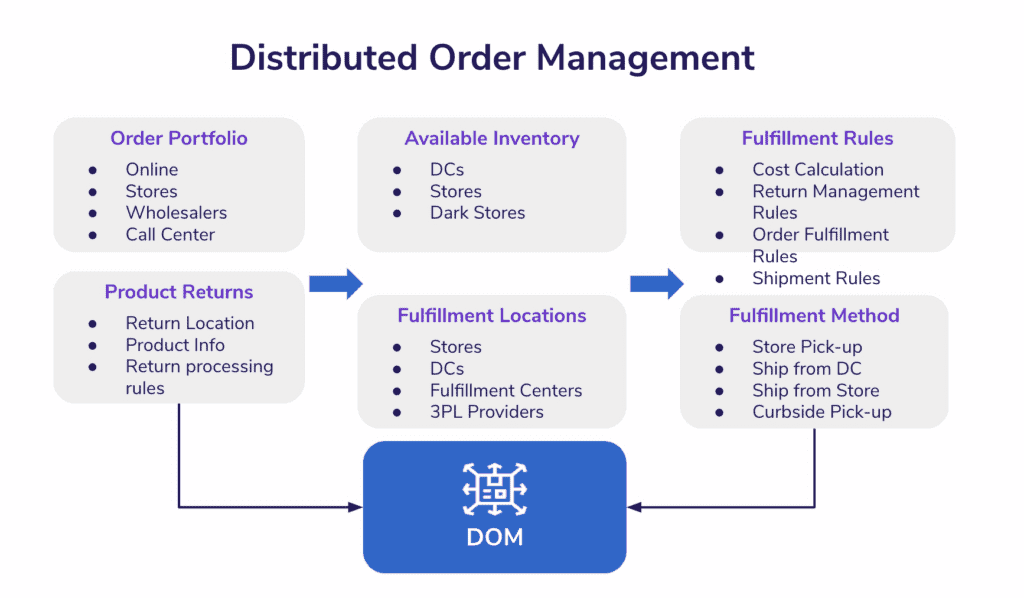
An order management system records the order. DOM sits inside or on top of it and makes one decision per order: who ships this? It takes four inputs and gives one answer:
- Stock by location: how many units of each SKU sit in each warehouse right now.
- Destination: the customer's country, and sometimes the region.
- Promise: the delivery speed you showed at checkout, such as standard or express.
- Cost: shipping, handling and, since every parcel from China to the US now pays duty, the import cost.
The output is a location for each line of the order, ideally one location for the whole order. If you only have one warehouse, you don't need DOM at all: every order goes there. It becomes useful the day you hold stock in a second place. For the bigger picture of what an OMS handles, see what order management covers.
The three places an order can ship from
| Source | Speed to the customer | Cost picture | Best for |
|---|---|---|---|
| Overseas warehouse in the customer's market | Fastest: 1–5 days of domestic delivery with our partner warehouses | Stock is imported in bulk, so duty is paid once per shipment rather than per parcel; storage is charged in that warehouse | Steady sellers with predictable demand |
| China warehouse, item in stock | Dispatch within 24 hours, then international transit | No overseas storage; each US-bound parcel pays its own duty | The long tail, new products and markets without overseas stock |
| Bought after the order (dropshipping) | Slowest: sourcing first (4–5 days on average with us), then dispatch and transit | No inventory risk at all | Testing products before committing to stock |
Most sellers end up using all three at once: overseas stock for a few best sellers, China stock for the rest of the range, and sourcing-on-demand for anything still being tested. DOM is what keeps that mix from turning into manual decisions on every order.
Five routing rules that cover most stores
- Local first. If a warehouse in the customer's market holds every item in the order, ship from there.
- Keep the order whole. If no local warehouse holds everything, ship from the one location that does, usually China, rather than splitting the order.
- Split only on purpose. If no single location holds everything, decide by the gap: a short wait for the missing item usually beats two parcels; a long one may not. Our guide to partially fulfilled orders has a decision table.
- China as the universal fallback. Every destination without overseas stock routes to China, and so does any overseas SKU that runs out.
- Restock before the fallback kicks in. Set a reorder point for each overseas SKU. When stock drops to it, send the next bulk shipment, so orders don't quietly drift back to the slower route.
Write these down before you touch any settings. If you can't explain your routing in five sentences, customers will get inconsistent delivery times and your support team won't be able to say why.
Three orders, routed
Suppose you keep your two best sellers, a lamp and a phone stand, in a US warehouse, and your full range in China.
- Order A: one lamp to Texas. Rule 1 applies: ship from the US warehouse, delivered in 1–5 days, with no new customs entry because the lamp was imported in bulk.
- Order B: a lamp plus a cable organizer to Ohio. The organizer is only in China, so no US location holds the whole order. Rule 2 says ship both from China in one parcel. Your alternative is to split: the lamp arrives in days and the organizer follows later as a second parcel with its own shipping charge and its own duty. Choose one approach and apply it every time.
- Order C: a phone stand to Australia. No stock in Australia, so rule 4 routes it to China.
Setting up routing in Shopify
Shopify has order routing built in. It's in Settings > Shipping and delivery, under Order routing, and it applies once you have at least two active locations. The default rules run in this order:
- Minimize split fulfillments: prefers a location that can ship the whole order; failing that, the fewest packages.
- Stay within the destination market: prefers locations in the same market as the shipping address.
- Ship from closest location: prefers the nearest location, measured in a straight line, and breaks remaining ties.
You can also add Use ranked locations, to put locations in priority groups, and Use location metafields, to rank by a value you set, such as whether a warehouse has capacity. Rules run top to bottom, each narrowing the previous result. A few details catch people out:
- A location is skipped unless "Fulfill online orders from this location" is on, and unless it sits in a shipping zone that covers the destination.
- Routing looks at stock when the order is placed, and it doesn't prevent overselling.
- If the customer's address can't be located on a map, the closest-location rule is skipped.
The default order maps neatly onto the five rules above: "minimize splits" protects rule 2, "destination market" gives you rule 1. Test it with a few orders to different countries before you rely on it. If you use a fulfillment partner, also confirm with them which locations and SKUs they manage, so Shopify's routing and theirs agree.
What DOM needs to work
- Accurate stock per location, updated from real shelf counts. Routing on stale numbers sends orders to a warehouse that can't fill them.
- One SKU per product everywhere. If the China warehouse and the overseas warehouse use different codes, rules can't match them.
- Delivery promises per route. Checkout should show a time that matches where the order will actually ship from, not the fastest route you have.
- The duty math. Since the US $800 de minimis exemption ended, each parcel from China is its own import with its own duty. One bulk shipment into a US warehouse is one customs entry for hundreds of units, which is a large part of why moving steady sellers overseas pays.
Which products deserve overseas stock is mostly a question of demand and margin; our guide to 3PL services by stage covers when to take that step.
How PackQuay routes between China and overseas stock
You can keep stock in our own warehouse in Xinxiang and in our 18+ overseas partner warehouses. Orders from your store go to the location holding the stock: overseas for 1–5 day delivery, or China, where stocked orders leave within 24 hours (48 at peak). When an overseas SKU runs low, we can ship the next bulk restock from China. Overseas warehouse fees depend on the warehouse and destination, so ask us for a quote; see our 3PL fulfillment service or message us on WhatsApp.
FAQ
What is distributed order management?
It is the logic, usually built into an order management system, that decides which warehouse or location ships each order, and whether to split it, based on stock, destination, delivery promise and cost.
What is the difference between an OMS and DOM?
An OMS records and tracks orders through their whole life. DOM is the routing part: choosing where each order is fulfilled when stock sits in more than one place.
Do I need distributed order management with only a China warehouse?
No. With one location every order ships from there. Routing rules start to matter once you hold stock in a second location, such as an overseas warehouse.
Does Shopify have order routing?
Yes. Once a store has at least two active locations, order routing in Settings > Shipping and delivery assigns each order using rules such as minimizing split fulfillments, staying within the destination market and shipping from the closest location.
Should I split an order between a US warehouse and China?
Only on purpose. Splitting gets the local item there fast, but the second parcel costs its own shipping and, for US customers, its own duty. Many sellers ship the whole order from China whenever China holds every item.