
What Is an Ecommerce Fulfillment Center? How One Works Inside
Quick answer: An ecommerce fulfillment center is a warehouse built to ship individual online orders to consumers, usually for many sellers at once. You send your stock in and pass on your orders, either through a store connection or as an order file; the staff pick, pack and ship each one and send back the tracking numbers. Unlike a storage warehouse, it is laid out for speed and single units, with separate zones for receiving, storage, packing, shipping and returns. Fulfillment centers sit either near the factories or near your customers, and that location decides your delivery time and how US duties get paid.
A walk through the building
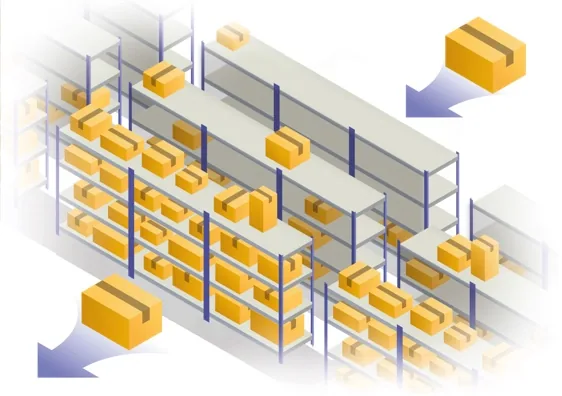
Every fulfillment center is organized around the path a product takes. Follow one unit from the truck to the customer and you pass through these zones:
- Receiving dock. Inbound cartons are unloaded and counted against what the seller said was coming. Ask any center how it reports shortages, and how fast.
- Inspection area. A sample of units is opened and checked for defects, wrong colors and missing parts. This is the cheapest place in the whole chain to catch a bad batch.
- Storage and pick locations. Each SKU gets a labeled location. Fast sellers sit closest to the packing area; slow stock goes higher or further back.
- Packing stations. Mailers, boxes, protective fill, your insert cards and a scale. The packer's box choice decides both the damage rate and the shipping bill.
- Value-added area. Labeling, bundling several products into one kit, building gift sets, re-boxing. These jobs are usually billed by labor time, and they are the heart of marketing fulfillment.
- Shipping and sorting. Labels are printed, parcels are sorted by carrier or shipping line, and handed over so tracking goes live.
- Returns area. Returned parcels are opened, graded, and either restocked or set aside.
The staff who run these zones are often called fulfillment specialists; our guide to the fulfillment specialist role covers what they do in a shift.
What you send in, and what you get back
A fulfillment center can only be as accurate as the information it receives. This is the exchange that makes it work:
| You provide | The center sends back |
|---|---|
| Stock, or a purchase list if the center buys for you | A receiving report: what arrived and what was damaged or short |
| Product data: SKU, barcode, weight, size, customs description | Stock levels by SKU |
| Packaging and inserts, or a spec to buy them | Inspection photos |
| Your orders, as a file or through a store connection | A tracking number for every order |
| Rules: which shipping line, what to do when a SKU runs out | Invoices for fees and shipping |
The last row is the one sellers forget. Without written rules, the center has to guess: hold an order when one of three items is missing, or ship two now and one later? Upgrade a parcel to a faster line or not? Agree these answers once, in writing, and you avoid a stream of questions and surprise charges later.
Three kinds of fulfillment center
For a store selling products made in China, the first question isn't "which company" but "where should my stock sit?".
| Origin (in China) | Destination (in your market) | Marketplace-run (such as Amazon FBA) | |
|---|---|---|---|
| Where stock sits | Close to the factories | Close to your customers | Inside the marketplace's own network |
| Delivery time | International: depends on the shipping line | Short domestic delivery | Short domestic delivery |
| US duties | Paid per parcel, as each one crosses the border | Paid once, on the bulk shipment | Paid once, on the bulk shipment |
| Cash tied up in stock | Low: small batches, quick top-ups from the factory | Higher: larger batches shipped ahead | Higher |
| Fits | New products, testing, wide catalogs | Proven best-sellers | Products sold mainly on that marketplace |
Since the US ended duty-free entry for low-value parcels from China in 2025, the per-parcel duty at origin is a real cost, which pushes steady sellers toward a destination warehouse. Many stores now run both: test and sell the long tail from China, and move best-sellers closer to customers. We compare the setups in four fulfillment setups. If Amazon is one of your channels, a China warehouse can also prepare stock for FBA: apply Amazon labels, pack to Amazon's requirements and ship it to Amazon's warehouses (see Amazon FBA prep).
What a fulfillment center charges for
Price lists look different, but almost every center bills the same handful of things:
- Receiving: sometimes free, sometimes per carton or per hour.
- Storage: per pallet, shelf or cubic meter, per month.
- Pick and pack: a base fee per order, plus a fee for each extra SKU or unit.
- Packaging: standard mailers, or your custom boxes.
- Value-added labor: kitting, labeling, extra inspection, usually per hour.
- Shipping: the carrier cost, with or without a markup.
At PackQuay, an order with two different SKUs that comes in as your 25th paid order of the day costs $1.70 plus $0.85 for the extra SKU, so $2.55 in pick and pack, with shipping charged at cost. Storage is free for your first 2 months and while you have orders to process. The full line-by-line breakdown, with a worked order, is in our 3PL pricing guide.
Is a fulfillment center right for you yet?
It usually is when:
- You pack more orders a week than you want to, and packing is eating the time you need for marketing.
- You have products that sell every day, so holding a batch makes sense.
- Your orders include several items that should arrive together in one parcel.
- You are building a brand and want every parcel packed the same way; see D2C fulfillment.
It usually isn't yet when you are still testing products with a handful of orders. In that case, dropshipping from an agent costs less cash. If you're comparing a fulfillment center with a plain storage warehouse, read fulfillment center vs warehouse; once you're shortlisting, use our 7 steps to vet a center in China.
PackQuay's fulfillment center in Xinxiang
PackQuay runs its own fulfillment center in Xinxiang, Henan, with sourcing, inspection, storage and packing done by our own team. It can handle 8,000 orders a day, stocked orders leave within 24 hours (48 at peak), and parcels go out on 30+ shipping lines. Best-sellers can move to one of 18+ overseas 3PL warehouses for 1–5 day delivery. Message us on WhatsApp and we connect your Shopify or WooCommerce store for you. Orders come in automatically, and tracking numbers go back to your store once parcels ship. You can also send orders as a CSV or Excel file. There is no subscription or monthly fee. Send us your product list on WhatsApp, or see storage and warehousing.
FAQ
What is an ecommerce fulfillment center?
A warehouse designed to ship single online orders to consumers on behalf of sellers. It receives and stores stock, picks and packs each order, hands it to a carrier, sends the tracking number back to the store and usually handles returns.
How does a fulfillment center get my orders?
Either through a connection to your store or as order files you send in. At PackQuay, message us on WhatsApp and we connect your Shopify or WooCommerce store for you; orders come in automatically, and tracking numbers go back to your store once parcels ship. You can also send orders as a CSV or Excel file.
Should my fulfillment center be in China or in the US?
For new products and wide catalogs, a center in China keeps cash in stock low and lets you top up quickly from factories. For proven best-sellers, a US warehouse gives short domestic delivery and lets you pay duty once on a bulk shipment instead of on every parcel. Many stores use both.
What does a fulfillment center charge?
Typically receiving, storage, a pick-and-pack fee per order plus extra items, packaging, value-added labor such as kitting, and shipping. At PackQuay pick and pack starts at $2.00 per order and drops to $1.00 as daily volume grows.
Is Amazon FBA a fulfillment center?
Yes, it is a marketplace-run fulfillment network. It is built around Amazon's own rules and fees, so many sellers use it for Amazon orders and a separate fulfillment partner for their own store.