Custom Packaging for Dropshipping: Options, Ordering and Cost
Quick answer: Custom packaging for dropshipping comes in four main forms: printed poly mailers, padded (bubble) mailers, custom printed boxes, and paper inserts such as cards and stickers. To use any of them, your stock has to sit in a warehouse that packs your orders, because a marketplace seller won't swap their packaging for yours. You approve a design and a sample, your agent buys a batch, stores it next to your products and uses it on every order. Printed packaging is priced by design, size, material and quantity, so get a quote per design and work out what it adds to each order before you commit.
Why the packaging can't come from your supplier
Most stores start with a product page on AliExpress or a similar marketplace. Each seller ships in whatever bag they have, sometimes with their own flyer inside. You can't change that: they pack orders for thousands of stores at once.
Custom packaging only works when one party holds your stock and your packaging in the same building. That is usually a dropshipping agent or a fulfillment warehouse. Once your products are on its shelves, every order can go out in your mailer, with your card, packed the same way each time.
If you are still testing products one order at a time, use neutral packaging for now: no supplier invoice, no third-party flyer, nothing that names another store. Switch to branded packaging once a product sells steadily. We walk through that timing in our guide to moving from generic to branded dropshipping.
The four options, compared
| Option | Protection | Good for | Where your brand goes | Check before ordering |
|---|---|---|---|---|
| Printed poly mailer | Low: keeps out dirt and rain, no cushioning | Clothing, textiles, soft accessories | Front and back of the bag | Film thickness, opacity, a second seal strip if you accept returns |
| Padded (bubble) mailer | Medium: light cushioning | Small cosmetics, jewelry, phone accessories | Outer face | Usable inner size, which is smaller than the outer size suggests |
| Custom printed box | High: holds its shape | Fragile items, gift sets, products bought for the unboxing | Outside, inside the lid, inner flaps | Fit around the product, box style, inside or outside print, whether it needs an outer shipping layer |
| Inserts: cards, stickers, tissue | None | Any parcel, including plain ones | The whole card | A size that fits your smallest pack, paper weight, what the card asks the customer to do |
Rule of thumb: packaging protects the product first and carries the brand second. A beautiful box that arrives crushed does more harm than a plain one that arrives intact.
Printed poly mailers
The cheapest way to make the outside of the parcel yours. A one- or two-color logo prints cleanly; full-color photo prints cost more. Pick a size that fits your most common order snugly. A bag that is too big flaps around in transit, and too many sizes slow down packing.
Padded mailers
Right for small items that can scratch or bend but don't need a box. They weigh a little more and take more room than plain mailers, which matters on shipping lines priced by weight.
Custom boxes
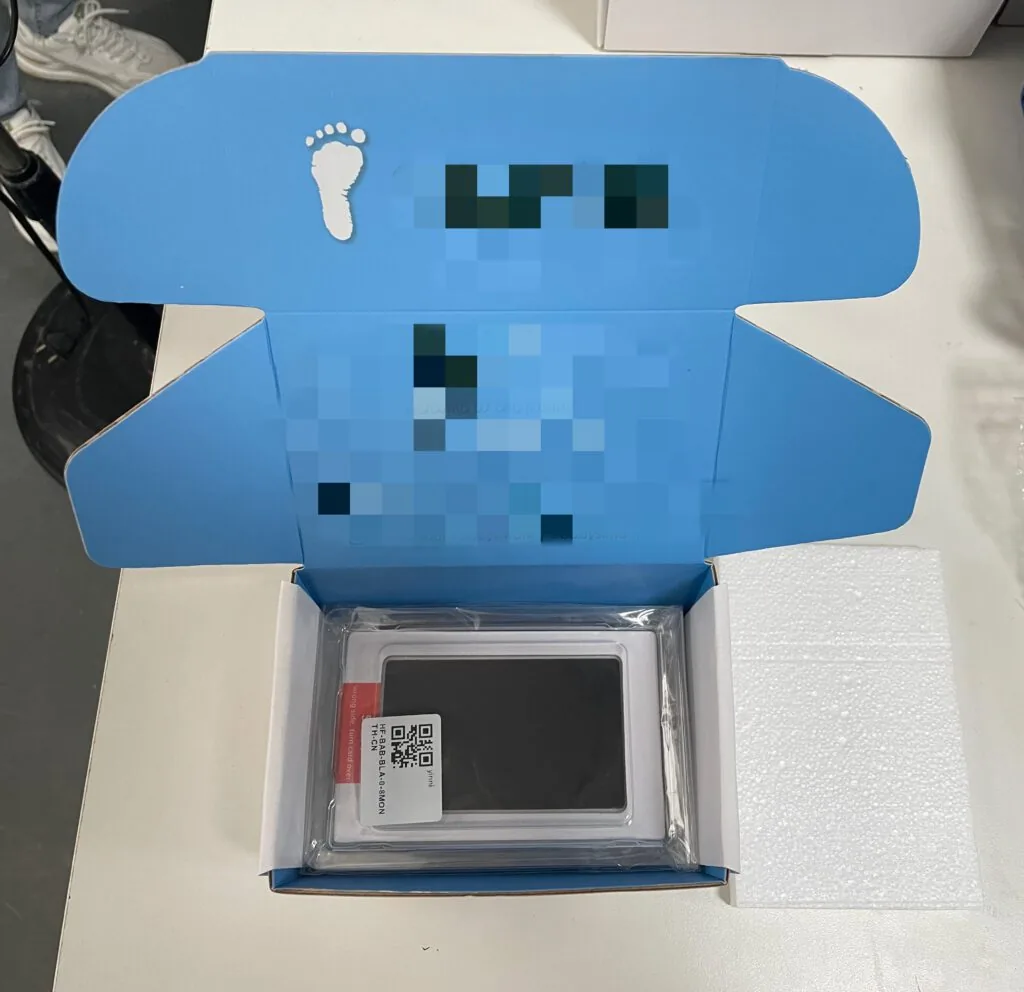
Mailer boxes, the fold-together style with a tuck-in lid, are the classic unboxing format. Printing inside the lid lets the box travel looking plain and look branded once opened. Boxes are the biggest packaging decision you'll make: they cost the most, take the most shelf space, and their size can move a parcel into a higher shipping bracket. Measure the product in its inner packaging before you settle on dimensions.
Inserts
The lowest-risk place to begin. A printed card fits inside any bag or box, has small minimums and is cheap to redesign. What to print on it, and how to stay within review rules, is in our thank-you card guide.
How to order custom packaging through your agent
- List which products need which packaging. Group your SKUs by size. Two mailer sizes and one box often cover a whole catalogue.
- Send the brief. Logo files (vector if you have them: AI, PDF or SVG), brand colors, product dimensions and weight, and roughly how many orders a month you expect.
- Ask for a quote at two or three quantities. That shows how the unit price moves, so you can choose a first run you will actually use up.
- Approve a proof, then a sample. Check the digital proof for spelling and colors, then the physical sample with the real product inside it.
- Order the batch and store it with your stock. Packaging takes shelf space too, so ask how it is counted for storage.
- Map packaging to SKUs. Tell your account manager which SKUs go in which bag or box, and what to do with mixed orders. From then on, every order is packed the same way without you checking.
How to think about the cost
We don't publish a fixed price for printed packaging, and you should be careful with anyone who quotes one without seeing your design. The price depends on four things:
- Type and size. A box costs more than a bag, and a large bag more than a small one.
- Material. Film thickness for mailers, board grade for boxes, paper weight for cards.
- Print. Number of colors, one side or both, inside printing, special finishes.
- Quantity. Printing has setup costs, so the unit price drops as the run gets bigger.
Then turn the quote into a per-order number: packaging unit cost, plus any insert, plus the pick-and-pack fee, plus shipping. Compare that with your selling price. Two costs are easy to miss:
- Shipping weight and size. Some lines price by actual weight, others also look at volume. A rigid box adds both, so ask for a shipping quote with the packaging included, not just the bare product.
- Dead stock. Thousands of boxes for a product you drop after two months are money on a shelf. Order packaging in step with sales, and use shared sizes where one mailer can serve several products.
Margins are also tighter than they were a few years ago. Since 2025, every parcel from China to the US owes import duties, because the $800 duty-free rule no longer applies. So judge packaging as part of the full landed cost per order (product, packaging, packing fee, shipping and duties), not on its own.
A starting setup that suits most stores
- While testing: neutral packaging plus a printed insert card.
- Once a product sells every day: a printed poly or padded mailer in one or two sizes.
- When the unboxing is part of what you sell (gifts, beauty, premium accessories): a custom box for that product line only.
If products arrive from the factory in packaging you don't want customers to see, that is a different job. See what repackaging is and when you need it.
How PackQuay handles custom packaging
We print mailing bags, padded mailers, custom boxes and card inserts, keep them in our Xinxiang warehouse next to your stock, and pack every order with them. Inserts can be turned around from 2 days. Packaging is quoted per design and volume. Storage is free for your first 2 months and while you have orders to process, and pick and pack starts at $2.00 per order (full table on our pricing page). More on the service on our packaging and branding page.
Send your logo and product sizes to your account manager on WhatsApp and we'll quote the options that fit.
FAQ
Can you get custom packaging when dropshipping?
Yes, as long as your stock is held by an agent or warehouse that packs your orders. Marketplace sellers pack orders for thousands of stores in their own packaging and won't switch to yours.
What is the cheapest custom packaging for dropshipping?
Usually a printed insert card, followed by a printed poly mailer. Both suit most products and put your brand on the parcel without the cost and shelf space of boxes.
Is there a minimum order for custom mailers and boxes?
Printed packaging is produced in runs, so there is normally a minimum, and it depends on the packaging type. Ask for quotes at two or three quantities to see how the unit price changes.
How long does custom packaging take?
Allow time for a proof, a physical sample and the production run before the first branded order ships. At PackQuay, printed card inserts can be turned around from 2 days; mailers and boxes depend on the design.
Do custom boxes make shipping more expensive?
They can. A rigid box adds weight and size, and some shipping lines price on volume as well as weight. Get a shipping quote with the packaging included before ordering a large run.