
What Does SKU Stand For? Meaning and How to Write SKU Codes
Quick answer: SKU stands for stock keeping unit. It is a code you create to identify each distinct item you stock and sell, down to the variant: a black T-shirt in medium and the same shirt in large are two SKUs. Unlike a UPC barcode, a SKU is internal, so every business writes its own. A good SKU is short, readable and built from a fixed pattern, such as TEE-CRW-BLK-M for a black crew-neck T-shirt in size medium.
What "stock keeping unit" actually means
Take the phrase apart. Stock is what you hold and sell. Keeping is tracking it: counting it, finding it, reordering it. A unit is the smallest thing you count separately. Put together, one SKU is one thing a picker can take off a shelf without having to ask "which one?"
That gives you a simple rule. If two items can't be swapped without the customer noticing, they need different SKUs. If they can, they share one.
What gets its own SKU
| Change | New SKU? | Why |
|---|---|---|
| Different color or size | Yes | The customer ordered a specific one |
| Different material or a new spec version | Yes | Not interchangeable, and complaints must trace to the right version |
| Same item from a second factory, same approved spec | Usually no | Record the supplier on the purchase or batch instead |
| Multi-pack, such as 3 pairs of socks | Yes | It is counted and sold as one unit |
| Bundle of different products | Yes, for the bundle | The parts keep their own SKUs too |
| Different packaging the customer sees, such as a gift box | Usually yes | It is a different item at the shelf |
| Price change or sale | No | Price is not a property of the item |
| Stock held in another warehouse | No | Location is a field, not a new product |
How to build a SKU code in five steps
- Choose your segments. Go from general to specific: category, then style or model, then the variant details such as color and size. If you run more than one brand, add a short brand prefix at the front.
- Give each value a short code. Two to four characters is plenty: BLK, WHT, NVY for colors; S, M, L, XL for sizes; a readable abbreviation for each model.
- Fix the order and the separator. Always the same sequence, always hyphens between segments. Never mix TEE-BLK-M with BLK-TEE-M.
- Set rules for the odd cases. Bundles start with KIT, multi-packs end with the pack size (3PK), a spec change adds V2.
- Write it all down. Keep a one-page SKU key listing every segment and code, so a new team member, a freelancer or your warehouse can read any SKU without asking you.
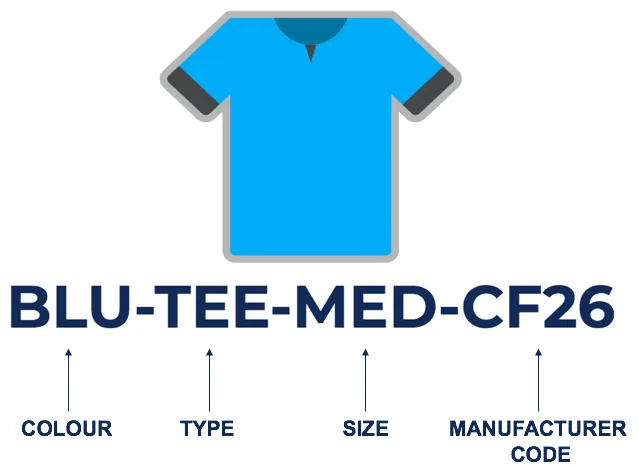
The example above ends in a manufacturer code. That works only if you will always buy from that factory. If you might switch suppliers, leave it out, or the SKU stops being true the day you change.
SKU format examples
| Product | Pattern | Example SKU |
|---|---|---|
| Crew-neck T-shirt, black, medium | CATEGORY-STYLE-COLOR-SIZE | TEE-CRW-BLK-M |
| Foldable phone stand, white | CATEGORY-STYLE-COLOR | STND-FLD-WHT |
| Ankle socks, white, 3-pack | CATEGORY-STYLE-COLOR-PACK | SOCK-ANK-WHT-3PK |
| Yoga starter kit (mat, strap, blocks) | KIT-NAME | KIT-YOGA-START |
| Second brand's dog bowl, green, large | BRAND-CATEGORY-COLOR-SIZE | B2-BOWL-GRN-L |
| Desk lamp after a spec change | CATEGORY-STYLE-COLOR-VERSION | LAMP-DSK-BLK-V2 |
A starter SKU key you can copy
Here is what the one-page key from step 5 looks like for a small apparel store. Swap in your own categories and keep it next to your product spreadsheet.
| Segment | Position | Codes |
|---|---|---|
| Category | 1st | TEE = T-shirt, HOOD = hoodie, CAP = cap |
| Style | 2nd | CRW = crew neck, VNK = V-neck, OVS = oversized |
| Color | 3rd | BLK, WHT, NVY, GRY |
| Size | 4th | XS, S, M, L, XL, 2XL |
| Extras | Last | 3PK = 3-pack, V2 = second version; bundles start with KIT |
With this key, HOOD-OVS-GRY-XL needs no explanation, and the next product you add slots straight into the same pattern.
Mistakes that break SKUs
- Starting with a zero. Spreadsheets quietly drop leading zeros, so 0125 turns into 125 and stops matching your store.
- Letters that look like numbers. O and 0, I and 1 cause picking errors. Leave O and I out of your codes.
- Spaces and symbols. Slashes, hash signs, asterisks and spaces can break CSV imports and integrations. Stick to capital letters, numbers and hyphens.
- Encoding things that change. Price, supplier, warehouse or season don't belong in a SKU. When they change, the code becomes wrong or has to be renamed everywhere.
- Using the supplier's item number as your SKU. Keep it in a separate field. Otherwise switching factories means renaming your catalog.
- Reusing a retired SKU. Old orders, returns and sales reports then point at the wrong product. Retire codes for good.
- One item, several SKUs. If the same product has different SKUs in your Shopify store, your marketplace listing and your spreadsheet, stock counts will never agree.
- Codes too long to read. If a packer can't read it aloud in one breath, shorten it.
Where SKUs live, and why your warehouse cares
In Shopify, every variant has its own SKU field, with a separate barcode field for a UPC or EAN. In WooCommerce, the SKU sits in the product's Inventory tab, and each variation of a variable product can have its own.
When a warehouse ships your orders, the SKU is how an order line in your store gets matched to the right item on a shelf. A missing or duplicated SKU is a common reason an order can't be matched automatically and stops to wait for a person.
SKUs also show up in packing costs. At PackQuay, pick and pack is charged per order, plus a fee for each additional SKU and each additional unit. On a day's first 19 orders, an order for two units of the same SKU costs $2.00 + $0.50 = $2.50, while two different SKUs cost $2.00 + $1.00 = $3.00. The full table is on our pricing page.
A SKU is only one of several codes a product can carry. How it relates to UPC, EAN and Amazon's FNSKU, and how to manage one SKU across several warehouses and suppliers, is covered in our guide to SKUs in inventory management.
How PackQuay helps
When you connect your Shopify or WooCommerce store, we map your SKUs to the stock in our Xinxiang warehouse, so every order line points at the right item. Custom packaging and inserts can be assigned per SKU. If your catalog's SKUs are a mess, send us your product list on WhatsApp and we'll help you tidy the mapping before your first order ships.
FAQ
What does SKU stand for?
SKU stands for stock keeping unit. It is a code a business creates to identify each distinct item it stocks, including every color and size variant.
What is an example of a SKU?
TEE-CRW-BLK-M could mean a crew-neck T-shirt in black, size medium. The same shirt in large would be TEE-CRW-BLK-L, a separate SKU.
Is a SKU the same as a UPC or barcode?
No. A SKU is an internal code you make up yourself. A UPC is a standard product number licensed from GS1 and printed as a barcode, and it stays the same whichever store sells the product.
How long should a SKU be?
There is no official length. Keep it short enough to read aloud in one breath, use only capital letters, numbers and hyphens, and follow the same pattern for every product.
Do I need SKUs if I dropship?
Yes. Your supplier or fulfillment partner uses the SKU to match each order line to the right product and variant, so missing or duplicate SKUs lead to wrong items or orders that stall.