
Dropshipping Pricing Strategy: How to Set the Price Tag (2026)
Quick answer: Price a dropshipping product in three steps. First, find the floor: landed cost (product, sourcing, packing, shipping, US duty) plus payment fees, your expected ad cost per sale and the minimum profit you'll accept. Never sell below it. Second, find the ceiling: what comparable offers cost and what the product is worth to the buyer. Third, choose where to sit between the two and use tactics that lift profit per order: a tiered markup, charm endings like $24.99, bundles and quantity breaks, a free-shipping threshold and duties-included pricing for US buyers. Then test two price points before you settle.
Step 1: your price floor
The floor is the lowest price at which an order still pays for itself, including the ad that won it.
Floor price = (landed cost + ad cost per sale + minimum profit + fixed payment fee) ÷ (1 − percentage payment fee)
Worked example for a made-up product. Sourcing (10% of goods on batches up to $5,000) and pick and pack ($2.00 on a day with fewer than 20 orders) are PackQuay's published rates; everything marked "example" is an assumption you'd replace with your own quote.
| Line | Per order |
|---|---|
| Product (example) | $2.60 |
| Sourcing fee, 10% | $0.26 |
| Pick and pack | $2.00 |
| Mailer (example) | $0.15 |
| Shipping, duties-paid line (example) | $4.40 |
| US duty (example) | $0.70 |
| Landed cost | $10.11 |
| Ad cost per sale (example starting assumption) | $9.00 |
| Minimum profit you'll accept | $4.00 |
| Payment fees (example) | 3% + $0.30 |
| Floor price | ($10.11 + $9.00 + $4.00 + $0.30) ÷ 0.97 = $24.14 |
At $24.99 this order keeps $4.83 after every cost. At $19.99 it loses money, however good the conversion rate looks. Duty belongs in the floor because every parcel from China to the US now pays it; the $800 duty-free rule no longer applies.
Step 2: your price ceiling
The ceiling is set by what buyers compare you with. Check:
- Comparable offers on Amazon, TikTok Shop and independent stores, including their delivery times. A buyer can often get a similar item in two days elsewhere, so a slower delivery has to be offset by something: a better version, a fuller bundle, a brand they trust.
- Perceived value. What problem does it solve, and how does it look on arrival? Branded packaging and an insert card raise what a product seems worth at a small cost per order (see packaging and branding).
- Your proof. Real photos, real reviews and clear policies support a higher price. A thin product page doesn't.
If the ceiling sits below the floor, no strategy will fix it. Change the product, the bundle or the supplier.
Step 3: pick a strategy
| Strategy | How it works | Use it when | Watch out for |
|---|---|---|---|
| Tiered markup | Multiply landed cost by a factor that shrinks as cost rises | You sell many products and want one consistent rule | It ignores what buyers will pay; always check against the ceiling |
| Competitor anchoring | Price relative to similar offers | The product is easy to compare | A race to the bottom; compete on the offer, not the number |
| Value-based | Price on the problem solved and how the product presents | Your version is clearly better or better branded | Needs proof on the page |
| Charm endings | $24.99 instead of $25 | Impulse and mid-priced products | Round numbers can suit premium positioning better |
| Bundles and quantity breaks | 2-packs, 3-packs, "complete the set" | Products used in multiples or with add-ons | Keep bundles simple to pack |
| Free-shipping threshold | Free shipping above an order value | You want bigger orders | Below the threshold, shipping still has to be covered somewhere |
| Duties-included pricing | One all-in price, duty prepaid | Every US order shipped from China | Say it clearly on the product page and at checkout |
Markup vs. margin: the conversion table
Markup is the multiple you apply to cost; margin is the share of the price you keep. Confusing them is the most common pricing error. Our profit margin guide explains how much gross margin you need once ads are paid.
| Price ÷ landed cost | Gross margin |
|---|---|
| 1.5× | 33% |
| 2× | 50% |
| 2.5× | 60% |
| 3× | 67% |
| 4× | 75% |
If you use a tiered markup, here's one example of bands to adapt to your own ad costs: landed cost under $8, multiply by 3 to 4; $8 to $20, by 2.5 to 3; $20 to $50, by 2 to 2.5; over $50, by 1.6 to 2. Cheap items need bigger multiples because ad costs don't shrink with the price.
Bundles: the math that makes them work
A second unit in the same order costs far less than a second order. Take the example above and offer a 2-pack at $39.99.
- Extra cost of the second unit: product $2.60, sourcing fee $0.26, pick and pack $0.50 (our rate for each extra unit of the same SKU on a day with fewer than 20 orders), extra shipping weight $1.30 (example) and extra duty $0.70 (example) = $5.36.
- Landed cost of the 2-pack: $10.11 + $5.36 = $15.47.
- Profit per order: $39.99 − $15.47 − $1.50 payment fees − $9.00 ad cost = $14.02, against $4.83 for a single unit.
The buyer pays $20 a unit instead of $24.99, and you earn almost three times as much per order, assuming the same ad cost wins it. A different product as an add-on works the same way; on our rates each extra SKU in an order adds $1.00 to pick and pack, and it all ships as one parcel.
Low-ticket vs. high-ticket
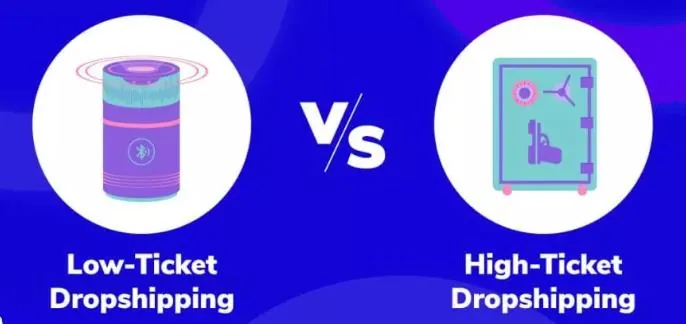
Low-ticket products live on bundles, quantity breaks and charm prices, because per-order costs take a big bite out of a small price. High-ticket products need a lower multiple but a much stronger case for the price: detailed pages, solid packaging, a returns plan. If you're heading that way, read our high-ticket sourcing guide first.
When to change your price
- When costs move. Recalculate the floor whenever shipping, duty or factory prices change.
- When ad costs climb. A rising cost per sale pushes your floor up. Raise the price, add a bundle, or accept that the product is fading.
- When you improve the offer. Better packaging, a fuller kit or faster delivery from stock are good moments to move up.
- Not below the floor for a promotion. Work every discount out from the floor, not from the list price.
To compare two prices, run them one after the other at the same budget, or offer a single unit and a bundle side by side. Judge on profit per order, not conversion rate alone. Our guide to testing products sets out the stop rules.
How PackQuay helps
Pricing starts with an accurate landed cost, so that's what we give you first. Send a product link on WhatsApp and your account manager quotes product, sourcing, packing and duties-paid shipping to your market. Our fees are published on the pricing page with no subscription, multi-item orders go out as one parcel, and we can pack bundles and add-ons under your brand.
FAQ
What is the best pricing strategy for dropshipping?
Start from a floor based on landed cost, ad cost per sale and minimum profit, check it against what comparable offers cost, then use a tiered markup with charm endings and bundles. There's no single best strategy, but pricing without a floor is the most common way to lose money.
What markup should I use for dropshipping?
Work back from the margin you need. A 2× markup on landed cost gives a 50% gross margin and a 3× markup gives 67%. Cheaper products usually need higher multiples because ad costs don't shrink with the price.
Should I offer free shipping on dropshipping orders?
Free shipping helps conversion, but the cost still has to be covered. Build it into product prices, or set a free-shipping threshold that encourages bigger orders.
Should my prices include US import duties?
For US orders shipped from China, yes. Every parcel now pays duty, so ship duties paid, include the duty in your price and say "duties included" so the customer never gets a bill at the door.
How do I price a bundle?
Add up the extra cost of each additional unit (product, sourcing, the extra-unit packing fee, extra shipping weight and duty), then set a bundle price that gives the buyer a lower per-unit price while your profit per order rises.
Should I match my competitors' prices?
Use them to find your ceiling, not your price. If you can't beat a competitor on price without going below your floor, compete on the offer: a better version, a bundle, branding or faster delivery from stock.