How Amazon Dropshipping Works From China: Source to FBA in 2026
Quick answer: Selling China-made products on Amazon usually runs in two stages. First you test a product with merchant-fulfilled orders shipped one by one from China. When it sells steadily, you move it into FBA: buy a batch from the factory, inspect it, prep and label every unit to Amazon's rules, pack compliant cartons and ship them to the Amazon warehouses your shipment plan assigns. Since January 1, 2026 Amazon no longer preps or labels inventory for US FBA, so all of that has to be finished before the goods leave China.
The two stages
| Stage 1: test (merchant fulfilled) | Stage 2: scale (FBA) | |
|---|---|---|
| Where stock sits | A warehouse in China | Amazon's US fulfillment centers |
| How each order ships | One parcel from China, with tracking uploaded to Seller Central | Amazon picks and ships it |
| Prime badge | No | Yes |
| Upfront stock | Small | A full batch, plus freight and duty |
| Good for | Finding out whether a product sells | Products with steady daily sales |
Stage 1 has its own rules on paperwork, handling time and returns; our guide to Amazon's dropshipping policy covers them. For the cost side of the switch, see FBA vs MFN with real fees. The rest of this guide is the practical work of stage 2.
Stage 2, step by step
Step 1: Source and confirm the carton specs
Ask the factory for more than a unit price. You need the retail package size and weight, units per master carton, and carton dimensions and weight, because Amazon caps carton size (see step 7). Check early whether the product is restricted in FBA or counts as dangerous goods. Products with batteries, aerosols or flammable liquids usually need extra review. Then order samples and compare them with your listing photos. Our sourcing service handles quotes, samples and factory follow-up.
Step 2: Decide how each unit will be barcoded
Amazon ended commingled inventory on March 31, 2026. If you hold the Brand Representative role in Amazon Brand Registry, eligible products can use their manufacturer barcode (UPC or EAN). Everyone else needs an Amazon FNSKU label on every unit, even if the box already has a UPC. Decide this before production: if the factory prints the FNSKU on the retail box, you save a labelling step later.
Step 3: Create the shipment in Seller Central
In the Send to Amazon workflow you enter the units, how they are packed and the carton weights and sizes. Amazon then offers placement options. Its optimized split sends cartons to several warehouses and carries no placement fee; sending everything to fewer locations costs a fee per unit. Once you confirm, you print an FBA box ID label for every carton. Each label belongs to one specific box, so print them only when the final carton count is known.
Step 4: Inspect before anything is labelled
Labelled units are hard to rework, so inspect first. Check the count against the purchase order, function, color and size against the approved sample, retail packaging for damage, and whether any barcode already on the box scans. Defective units sent into FBA come back as returns, bad reviews and removal fees. See how our product inspection works.
Step 5: Prep each unit
| Product type | Typical prep |
|---|---|
| Loose items, textiles, items with small parts | Clear poly bag, at least 1.5 mil thick, fully sealed, barcode readable through the bag |
| Any poly bag with an opening of 5 inches or more | Printed or stickered suffocation warning |
| Multipacks and bundles | Bagged or shrink-wrapped together, with a "Sold as set, do not separate" label |
| Glass, ceramics and other fragile items | Protective wrap or a box that survives handling; no loose fill such as packing peanuts |
| Boxed items that can open | Taped or sealed so the box stays closed |
Amazon publishes detailed prep rules by category in Seller Central, and they change, so check your category before production. Since January 2026, units that arrive badly prepped or labelled can be delayed at check-in, and they lose reimbursement eligibility if they are damaged or can't be traced.
Plan bundles with one more date in mind: from January 11, 2027, most bundles sold under a single ASIN in the US must be packaged by the original manufacturer or brand. Kits made only from your own private label products are fine; kits that mix other brands' goods need a letter of authorization from each brand.
Step 6: Label each unit
- Print FNSKU labels with a thermal or laser printer, never inkjet, on removable, non-reflective labels between 1 × 2 and 2 × 3 inches.
- Cover every other scannable barcode on the unit so only one can be read.
- Place the label on a flat surface, not across a corner, a curve or a seam.
- Scan a sample of labelled units before packing to confirm they read correctly.
Step 7: Pack and label the cartons
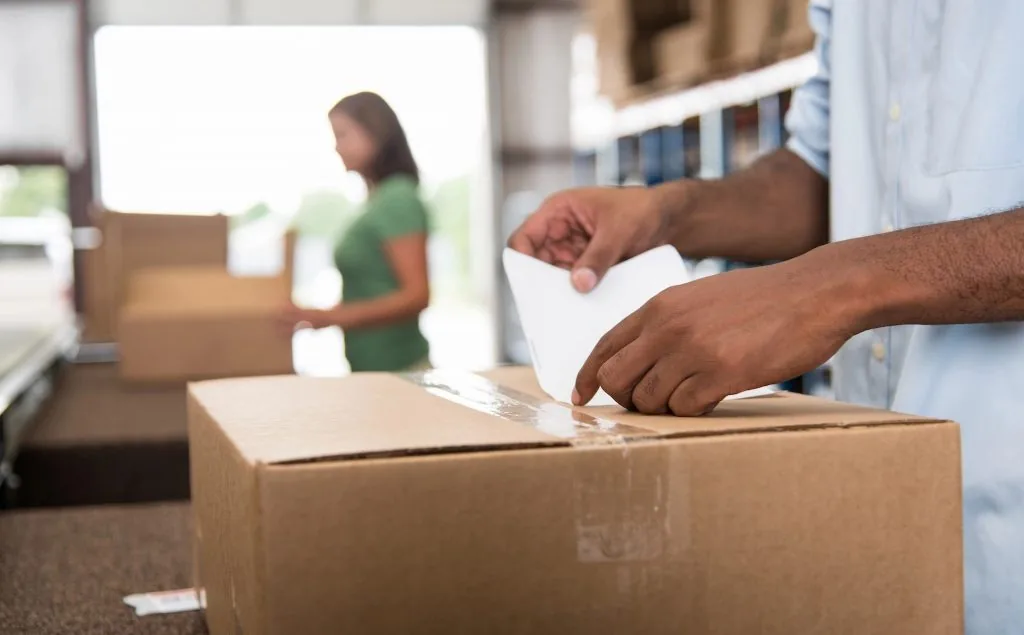
- Rigid six-sided corrugated boxes with all flaps intact.
- No more than 50 lb per box, unless one single item is heavier on its own.
- No side longer than 36 inches, and the other two sides no longer than 25 inches. Amazon raised the length limit in June 2025; Amazon Warehousing and Distribution (AWD) still uses 25 inches on all sides.
- One FBA box ID label per carton, on a side, clear of seams and edges, matching that exact box.
- Box content information entered in Seller Central for every carton. Missing it means slower check-in and a manual processing fee.
- Cover or remove the factory's old shipping marks and barcodes on reused cartons.
Step 8: Ship and clear US customs
Choose air or sea freight and book it with a forwarder, or use Amazon Global Logistics. Your shipment needs an importer of record and US duties paid before it reaches an Amazon warehouse: Amazon will not act as importer of record and expects FBA shipments to arrive duties paid. Sellers who want to stage stock in China can use Amazon's Global Warehousing and Distribution hub in Shenzhen, open since April 9, 2026, which replenishes US fulfillment centers from there. Our comparison of every route to the Prime badge explains how it fits.
Step 9: Track check-in and reconcile
After delivery, compare units received with units shipped for each SKU in Seller Central. Raise discrepancies quickly, with your packing list and carton photos. Reconciliation is much easier when every carton was photographed and weighed before it left the warehouse.
What usually goes wrong
| Problem | Usual cause | Fix before shipping |
|---|---|---|
| Units misrouted or held at check-in | Two scannable barcodes on one unit | Cover the factory barcode with the FNSKU label |
| Carton refused or reworked | Over 50 lb or over the size limit | Split into smaller master cartons |
| Bundle sold as single pieces | No "sold as set" label | Bag the set together and label it |
| Slow check-in, extra fees | Missing box content information | Enter contents per carton before printing labels |
| Wrong quantity received | Box ID labels swapped between cartons | Label each carton as it is sealed, not in a batch at the end |
How PackQuay runs this for you
PackQuay provides FBA prep and shipping from our own warehouse in Xinxiang, Henan. We source from factories (fee from 10% down to 4% of goods value), inspect 20% of each batch free, apply Amazon labels, pack to Amazon's requirements and ship the goods to Amazon's warehouses. FBA prep is priced per unit, from $0.10 for an FNSKU label (see Amazon FBA prep), freight is at cost, and storage is free for the first 2 months. While a product is still being tested, we ship your merchant-fulfilled orders one by one from the same stock. Send us your product and shipment plan on WhatsApp.
FAQ
How does Amazon dropshipping from China work?
You list a product, test it with merchant-fulfilled orders shipped one by one from China, and when it sells steadily you send a batch to FBA. The batch is sourced, inspected, prepped, labelled and packed in China, then shipped to the Amazon warehouses in your shipment plan.
Does Amazon still prep and label FBA inventory?
Not in the US. Amazon stopped offering prep and item labeling for US FBA shipments created on or after January 1, 2026, so units must arrive already prepped and labelled by you, your factory or a prep service.
Can my supplier in China ship directly to Amazon FBA?
Yes, as long as the goods arrive prepped, labelled and packed to Amazon's rules and someone acts as importer of record and pays US duties. Many sellers send goods through a prep warehouse in China so they can be inspected and labelled first.
What size can an FBA shipping carton be?
For US FBA, a carton can weigh up to 50 lb and measure up to 36 inches on its longest side and 25 inches on the other two, unless it holds a single item that is larger on its own. Amazon Warehousing and Distribution still uses 25 inches on every side.
Do I need FNSKU labels if my product has a UPC?
Since Amazon ended commingling on March 31, 2026, sellers without the Brand Representative role in Brand Registry need an FNSKU label on every unit, even with a UPC. Eligible brand owners can keep using the manufacturer barcode.