
Amazon FBA vs MFN in 2026: Real Costs per Order, Compared
Quick answer: With FBA you pay Amazon per unit to store and ship your stock: for example $3.78 to fulfill a 12 oz small-standard item priced between $10 and $50, plus a 3.5% fuel and logistics surcharge since April 2026, monthly storage and, on some shipments, a placement fee. With MFN (merchant fulfilled, also called FBM) those fees disappear and are replaced by your own pick and pack, postage, returns and, if you ship from China, US duties on every parcel. The referral fee is the same either way. FBA usually wins for small, steady sellers that need Prime; MFN wins for testing, bulky, slow or customized products.
The two models in one line each
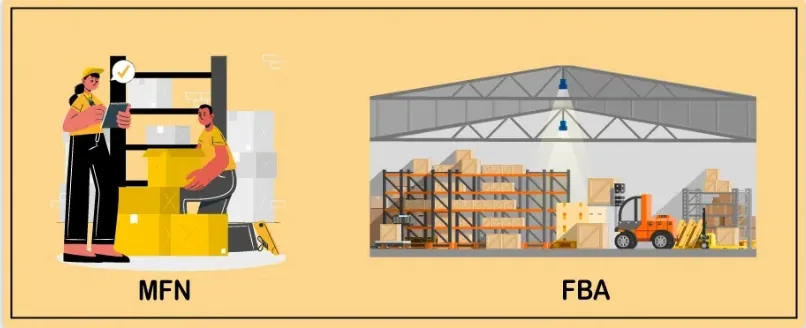
- FBA (Fulfillment by Amazon, AFN in Amazon reports): you send bulk stock to Amazon's warehouses; Amazon picks, packs, ships, handles customer service and processes returns.
- MFN (Merchant Fulfilled Network, the same thing sellers call FBM): you keep the stock, in your own warehouse, a 3PL or a fulfillment partner abroad, and ship every Amazon order yourself.
MFN offers get no Prime badge unless you qualify for Seller Fulfilled Prime, which requires stock in the US and very fast delivery.
Every cost line, side by side (2026 US rates)
| Cost | FBA | MFN |
|---|---|---|
| Referral fee | 15% in most categories ($0.30 minimum) | Same |
| Fulfillment | Per-unit fee by size, weight and price band (new rates from January 15, 2026), plus 3.5% fuel and logistics surcharge from April 17, 2026, plus a holiday peak fee from October 15 to January 14 | Your pick and pack fee plus postage for each parcel |
| Storage | $0.78 per cubic foot per month January–September, $2.40 October–December (standard size); aged-inventory surcharges after 181 days | Your warehouse or 3PL storage |
| Getting stock in | Freight to Amazon, a placement fee ($0 on Amazon's optimized split, $0.14–$0.32 per unit for small-standard items sent to one location), plus prep and labels, which Amazon stopped doing for US shipments on January 1, 2026 | Freight to your US warehouse, or nothing if you ship each order from China |
| Running low | Low-inventory-level fee per unit when you hold under 28 days of supply | No fee, but a stockout means cancellations |
| Returns | Amazon processes them | You pay for return labels and handle the item |
| US duties | Paid once per bulk import | If shipped from China, owed on every parcel, since duty-free entry under $800 has ended |
New sellers should also look at Amazon's FBA New Selection program for 2026, which offers free monthly storage and referral fee discounts on eligible new products. Check whether your listings qualify before you run the numbers.
Worked example: one 12 oz product at $24.99
Assume a small-standard item, 12 oz shipping weight, in a 7 × 5 × 2 inch box (0.04 cubic feet), selling for $24.99 outside the holiday peak. The referral fee ($3.75) is identical under both models, so we leave it out and compare only what changes.
FBA, per unit
- Fulfillment fee: $3.78
- Fuel and logistics surcharge (3.5%): $0.13
- Storage for about two months on hand: 0.04 cu ft × $0.78 × 2 = $0.06 (it more than triples if the stock sits there in October–December)
- Placement fee: $0 if you accept Amazon's split, up to $0.32 if you ship everything to one warehouse
- Plus: your share of bulk freight and duty, and the labor to apply an FNSKU label to each unit
Amazon's fees come to about $3.97–$4.29 per unit, before freight, duty and labelling.
MFN shipped from China through PackQuay, per order
- Pick and pack: $2.00 per order on your first 19 paid orders of the day, falling to $1.70, $1.50, $1.20 and $1.00 at 149+ orders. See our pricing page.
- Postage to the US: charged at cost by weight and shipping line.
- US duty: owed on every parcel. Ship duties paid (DDP) so the buyer is never billed at the door; our international shipping guide explains how to quote it.
- Returns: a prepaid label or a refund without return. Shipping a $24.99 item back to China rarely makes sense.
Which is cheaper?
MFN from China costs less only when postage + duty for one parcel is lower than the FBA fees you avoid + your bulk freight, duty and labelling per unit − the pick and pack fee. For a 12 oz item that bar is low, roughly $2–$2.30 plus whatever you would have spent getting the unit into FBA, so FBA usually wins on cost for small, light products that sell every day. The balance flips for bulky or heavy goods, where FBA fees climb fast, and for slow sellers, where storage and aged-inventory charges pile up.
Cost isn't the only factor. A parcel from China carries a delivery promise of days, not the one or two days a Prime shopper expects, so it converts worse on competitive listings.
The day-to-day work, compared
| Task | FBA | MFN |
|---|---|---|
| Shipping each order | Amazon | You or your partner, confirmed in Seller Central with valid tracking |
| Performance targets | Mainly stock levels and FBA capacity limits, set monthly in cubic feet | On-time delivery at least 90%, valid tracking above 95%, late shipments under 4%, cancellations under 2.5%, order defects under 1% |
| Handling time | Not your problem | Since June 29, 2026 each SKU's handling time must match how fast you really ship; if you don't set it, Amazon assigns one from your history |
| Late deliveries | Amazon's responsibility | From February 28, 2026 Amazon deactivates the individual listings that drag your on-time rate below 90% |
| Returns | Amazon | Amazon's prepaid return labels became mandatory for US seller-fulfilled orders on February 8, 2026; from December 18, 2026 you must provide a prepaid label or a full refund within 7 days |
| Packaging | Your product packaging, shipped in Amazon's box | Your own mailer, box and insert card |
When each model wins
Choose FBA when
- The product is small and light, and sells steadily every day.
- The listing is competitive and the Prime badge decides the sale.
- You sell mainly on Amazon and want Amazon to handle service and returns.
Choose MFN when
- You are testing a new product and don't want to commit stock to Amazon yet.
- Items are bulky, heavy, fragile or high-value.
- Sales are slow or seasonal, so storage would eat the margin.
- Orders are personalized, bundled or need your own packaging.
- The same stock also serves your Shopify or WooCommerce store.
Or run both
Most sellers end up hybrid: new products start as MFN shipped from China, winners move into FBA once daily sales are steady, and the slow long tail stays MFN. Our guide to managing FBA and MFN orders together covers the weekly routine and when to reorder.
How PackQuay helps with either model
For MFN, upload your Amazon orders to us as a CSV or Excel file and we pick, pack and ship them from our warehouse in Xinxiang, Henan, with pick and pack from $2.00 down to $1.00 per order and postage at cost. Stocked orders leave within 24 hours (48 hours at peak). For FBA, we apply Amazon labels, pack to Amazon's requirements and ship your goods to Amazon's warehouses, with FNSKU labelling at $0.10 per unit and freight at cost (all prices on our Amazon FBA prep page). Send us the product and your monthly volume on WhatsApp and we will price both routes.
FAQ
What is the difference between FBA and MFN on Amazon?
With FBA, Amazon stores your stock and ships every order for a per-unit fee, and your offers get the Prime badge. With MFN (merchant fulfilled, also called FBM), you keep the stock and ship each order yourself or through a partner, avoiding FBA fees but taking on delivery, returns and customer service.
How much does FBA cost per unit in 2026?
It depends on size, weight and price. A 12 oz small-standard item priced between $10 and $50 pays a $3.78 fulfillment fee from January 15, 2026, plus a 3.5% fuel and logistics surcharge added in April 2026, plus storage of $0.78 per cubic foot per month for most of the year and $2.40 from October to December. Check your exact fee in Seller Central's Fee Preview report.
Is MFN cheaper than FBA?
Sometimes. MFN avoids FBA fulfillment, storage and placement fees, but you pay pick and pack, postage and returns yourself, and parcels shipped from China owe US duty one by one. MFN is usually cheaper for bulky, heavy or slow-selling products, while FBA usually costs less for small items that sell every day.
Can I do MFN on Amazon by shipping from China?
Yes, as long as your handling and transit times are set honestly and you meet Amazon's seller-fulfilled targets, such as at least 90% on-time delivery and above 95% valid tracking. Delivery takes longer than Prime, so it works best for testing products or niche listings.
Does the Amazon referral fee change between FBA and MFN?
No. The referral fee is a percentage of the sale price, 15% in most categories with a $0.30 minimum, and it is charged the same way whichever fulfillment method you use.