
What Is 2PL Logistics? Second-Party Logistics With Examples
Quick answer: 2PL (second-party logistics) is a carrier that owns its transport assets, such as container ships, cargo planes, freight trains or trucks, and moves goods from one point to another for a fee. Ocean shipping lines, airlines, rail operators, trucking firms and parcel carriers are all 2PLs. A 2PL only does the move. You, the owner of the goods, still decide what ships and when, prepare the paperwork and arrange storage, unless you hand those jobs to a freight forwarder or a 3PL.
Where the "second party" sits
Logistics people number the parties by how much of the work they take off the owner of the goods:
| Party | Who it is | What it owns | What it does for you |
|---|---|---|---|
| 1PL | You: the manufacturer or seller | The goods, sometimes its own vans or stockroom | Everything, with its own staff |
| 2PL | A carrier | Ships, planes, trains, trucks | Moves goods on one leg of the journey |
| 3PL | A logistics operator | Usually a warehouse and its systems | Stores, packs and ships orders, booking carriers for you |
There is no official rulebook behind these labels, and providers use them loosely. A useful test is to ask: "What do you own, and what do you buy from someone else?" A company that owns the vessel or the truck on your leg is a 2PL for that leg. Our guide to 1PL to 5PL covers the levels above 3PL.
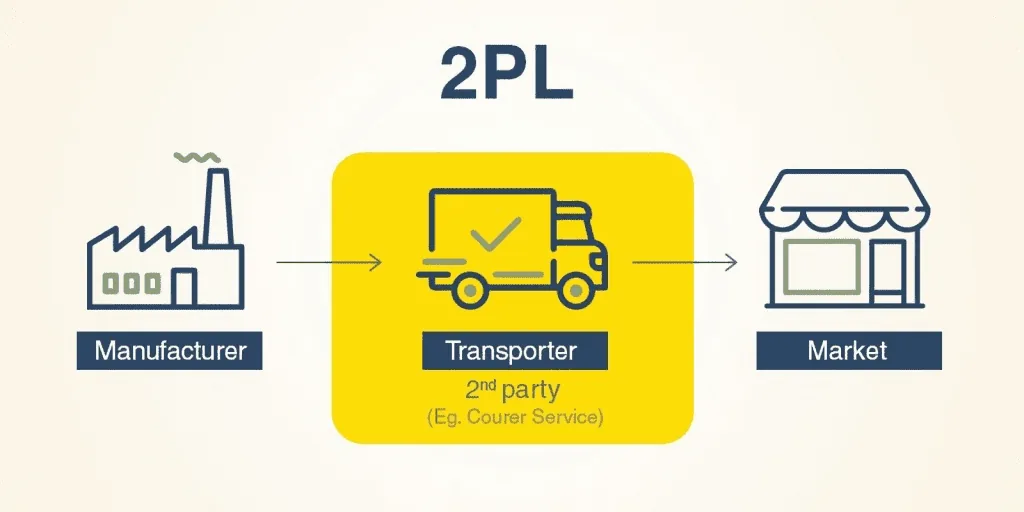
2PLs you already depend on
- Container lines carry full containers from port to port.
- Airlines fly cargo in passenger holds and freighters, airport to airport.
- Rail operators run freight trains, including services between China and Europe.
- Trucking companies handle the first and last stretch on land: factory to port, port to warehouse.
- Parcel carriers and postal services deliver single parcels to your customer. They are 2PLs too, just at parcel scale.
Small sellers rarely contract the big asset owners themselves. They usually buy container space through forwarders and NVOCCs, companies that buy space from the carrier and resell it to shippers, often with documents and customs help included. If you're comparing these middlemen, read what a freight agent does and how to pick one.
One bulk shipment, leg by leg
Follow a batch of cartons from a factory in China to a 3PL warehouse in the US. Several different 2PLs touch it, and none of them owns the whole trip:
| Leg | Who physically moves it | Is it a 2PL? | Who usually books it |
|---|---|---|---|
| Factory to export warehouse or port | A Chinese trucking company | Yes | The supplier or your forwarder |
| Export clearance in China | Nobody moves it; papers are filed | No: a customs agent | Your forwarder |
| Port to port, or airport to airport | A container line or an airline | Yes | A forwarder or NVOCC |
| US import entry and duty | Nobody moves it; the entry is filed | No: a licensed customs broker | Your broker, for the importer of record |
| Port to warehouse | A drayage or trucking company | Yes | Your forwarder |
| Warehouse to customer | A parcel carrier | Yes | The 3PL that packs the order |
The table shows the real weakness of using 2PLs on their own: each one answers only for its leg. Someone still has to line the legs up, keep the paperwork consistent and chase the carrier when a container misses its vessel. That coordinating job is what forwarders, customs brokers and 3PLs sell. The CFA vs. 3PL guide explains how those roles split.
When booking a 2PL directly makes sense
Going straight to the carrier is cheapest per leg when you have volume and staff to manage it. It suits a business that ships full containers on a regular schedule, has its own import team and already works with a customs broker. It rarely suits an online store moving a few hundred cartons a year.
| Book the 2PL yourself | Book through a forwarder or 3PL | |
|---|---|---|
| Price per leg | Lowest, if your volume earns contract rates | Includes a margin, offset by shared buying power |
| Minimum size | Often a full container or a large air shipment | Part loads (LCL), mixed cartons, single pallets |
| Paperwork | Yours | Prepared for you |
| Problems between legs | Yours to chase | One contact chases all legs |
| Storage and packing | Not included | Available from a 3PL |
What changed for 2PL shipments in 2025–2026
Two shifts matter if your goods come from China.
Duty on every parcel, so bulk freight matters more. The US $800 duty-free rule ended for China and Hong Kong in May 2025 and for every country in August 2025; in June 2026 US Customs made the suspension indefinite, and the law repeals it for good from July 1, 2027. Every parcel from China now owes duty. Moving stock in bulk on a 2PL to a warehouse in your market means one customs entry for the whole shipment instead of one per parcel. A shipment worth more than $2,500 goes through a formal entry, which needs a customs bond, and every entry names an importer of record, usually you. Plan that before the first container sails; our guide to running stock in overseas warehouses walks through it.
A 2PL network can stop overnight. When the US duty-free rule ended for all countries in August 2025, the Universal Postal Union reported that 88 postal operators had suspended some or all services to the US until they could collect duty in advance. Most have since restarted with duty-paid systems. The lesson for sellers: know which 2PL actually carries your parcels and keep a second route ready.
Checklist: booking a 2PL leg from China
- Measure the cargo. Carton count, size, gross weight, total cubic meters, and an HS code for each product.
- Flag restricted contents. Batteries, magnets, liquids and powders change which carriers and modes will accept the goods.
- Choose the mode. Air for urgent or high-value stock, sea for heavy or bulky goods, rail as a middle option to Europe.
- Agree trade terms with your supplier. Incoterms 2020 is still the current edition. EXW, FOB and DDP put the cost and the risk in very different places.
- Name the importer of record and confirm who files the import entry and pays the duty.
- Ask for a door-to-door quote that lists origin charges, freight, destination charges, customs and delivery separately.
- Insure valuable cargo. A carrier's liability is capped by law and usually far below what the goods are worth.
- Mark every carton with your SKU and quantity, so the receiving warehouse can count it fast.
How PackQuay helps
Our freight and 2PL service books air, sea (full and part container), rail and road freight from China. We combine goods from several suppliers into one shipment, prepare the commercial invoice, packing list and export documents, and deliver to your own 3PL, to Amazon FBA (see FBA prep) or to our overseas partner warehouses. Our Shenzhen team handles the forwarding. If we also buy or store the goods, they're counted at our warehouse in Xinxiang, Henan and 20% of each batch is inspected free before anything ships. Send your carton list and destination on WhatsApp for a door-to-door quote.
FAQ
What is 2PL in logistics?
A second-party logistics provider is a carrier that owns its transport assets, such as ships, planes, trains or trucks, and moves goods from one point to another. It handles the transport only; planning, paperwork and storage stay with the shipper or another provider.
What are examples of 2PL companies?
Container shipping lines, cargo airlines, freight rail operators, trucking companies, parcel carriers and national postal services all act as 2PLs when they physically carry your goods.
What is the difference between 2PL and 3PL?
A 2PL moves goods on one leg using its own vehicles or vessels. A 3PL runs a wider part of your logistics, typically storage, picking, packing and shipping, and books 2PL carriers for you as part of that service.
Is a freight forwarder a 2PL?
Usually not. A forwarder arranges transport on other companies' ships, planes and trucks and handles the paperwork around it, so it coordinates 2PLs rather than being one. Some large groups do both.
Do I need a 2PL if I dropship from China?
Every parcel travels on 2PLs, but you don't book them yourself. Your fulfillment partner picks a shipping line per order. You start dealing with 2PL freight once you move stock in bulk to an overseas warehouse or Amazon FBA.