
Sourcing Kitchen Products From China: FDA Rules, QC and Packing
Quick answer: Kitchen products are easy to source from China and easy to get wrong. Anything that touches food falls under US FDA food-contact rules, and the FDA does not certify or pre-approve kitchenware: the business that imports and sells it is responsible for making sure the materials are allowed. In practice that means starting with simple materials (stainless steel, food-grade silicone, glass), keeping a recent lab report for each item, inspecting every batch for odor, coating and fit problems, and packing breakables in boxes rather than mailers. Price every order with US duties included, because parcels from China no longer enter duty-free.
Why kitchenware needs its own sourcing plan
A phone case only has to look right. A spatula, lunch box or frying pan also has to be safe to cook and eat with, survive hot water and dishwashers, and arrive in one piece. Three things set this category apart:
- The material is regulated, not just the product. Every substance that touches food has to be legal for that use.
- Many items are fragile or sharp. Ceramic, glass, knives and slicers need more packing thought than a T-shirt.
- Sets are heavy and bulky. Cookware and bakeware sets cost more to ship than their retail price suggests, so landed cost decides whether a product is worth listing.
Choose by material, not by trend
The material decides your compliance homework, your inspection checklist and your packing cost. Run a product through this table before you send the link to a supplier:
| Product type | Typical material | Main risk | Ask the supplier for |
|---|---|---|---|
| Spatulas, baking mats, molds | Silicone | Cheap fillers, odor, staining | Food-contact test report for your exact grade and color |
| Storage boxes, lunch boxes | PP plastic, glass with plastic lids | Lids that leak, warping in hot water | Material grade, heat rating, leak test |
| Pots, pans, bakeware | Stainless steel, aluminum with nonstick coating | Coating chips, PFAS in the coating, heavy cartons | Coating type in writing, test report, carton weight |
| Plates, mugs, bowls | Ceramic, glass | Lead or cadmium in glazes, breakage | Lead and cadmium leaching test, packed drop test |
| Boards, utensils, trays | Bamboo, wood | Mold in transit, splits, glue lines | Moisture control, finish and glue details |
| Peelers, choppers, knives | Stainless blades, plastic bodies | Dull or uneven blades, cuts in transit | Steel grade, blade guards |
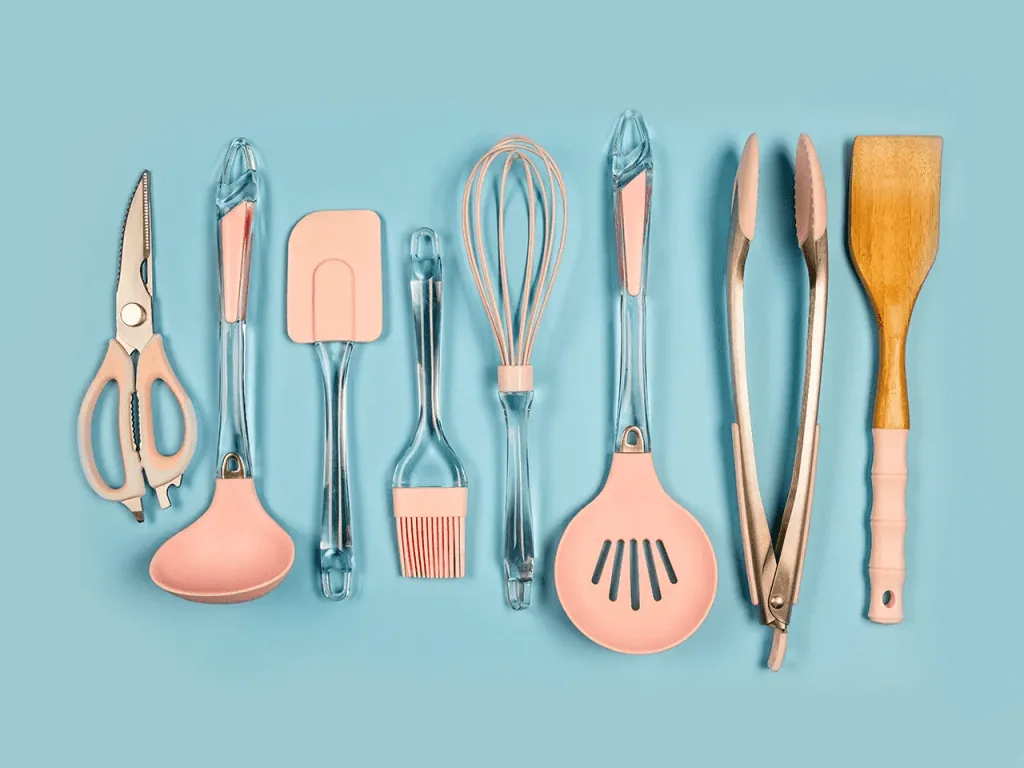
For a first product, stainless steel tools and plain silicone utensils are the lowest-risk picks: light, hard to break and simple to document. Nonstick coatings, decorated ceramics and plant-based "natural" tableware carry more homework.
FDA food-contact rules: what applies and who is responsible
US rules for materials that touch food sit in Title 21 of the Code of Federal Regulations, Parts 174 to 186. Each substance in a food-contact item has to be cleared for that use: listed in those regulations, generally recognized as safe (GRAS), covered by an effective food contact notification, or exempt under the FDA's threshold of regulation. Four points trip up sellers most often:
- No product-level FDA approval exists. The FDA says it does not certify, license or approve individual imported products or shipments. When a 1688 or Alibaba listing says "FDA approved", it usually means the factory once had a sample tested against FDA criteria. Ask to see that report, check the date, and check that it covers your item, material and color.
- The seller carries the responsibility. In a May 2025 letter, the FDA told retailers, distributors and importers that they are responsible for making sure the food-contact products they sell are safe and compliant. The same letter concluded that plates and bowls made from Areca palm leaf, widely sold as natural and eco-friendly, may not lawfully be sold in the US.
- Each material has its own rules. Silicone used repeatedly with food falls under the rubber rules in 21 CFR 177.2600. Ceramics and glass are checked for lead and cadmium leaching from glazes and decorations. If you have 10 or more employees and sell into California, Proposition 65 can also require a warning for dinnerware that exposes users to lead above its stricter thresholds.
- States are banning PFAS in cookware. Minnesota banned the sale of cookware with intentionally added PFAS from January 2025; Colorado and Maine followed in January 2026, and more states have bans scheduled from 2027. If you sell nonstick pans nationwide, choose a PFAS-free coating and get that confirmed in writing.
A simple routine works: ask for test reports before you order samples, pay for a lab test on your own production batch for higher-risk items such as glazed ceramics and coated pans, and keep every report in one folder. When a marketplace, a customer or customs asks, you can answer the same day.
What to inspect in every kitchen batch
Lab reports cover the material. Inspection covers the units you are about to ship. For kitchenware, check:
- Smell. Open a handful of silicone and plastic items. A strong chemical smell points to a cheap compound; hold the batch and ask the supplier before anything ships.
- Coatings. Look for bare spots, bubbles and chipped rims on nonstick surfaces.
- Glaze and glass. Check for cracks, chips, pinholes and peeling decals. Tap ceramics; a dull note can mean a hidden crack.
- Fit and seal. Close the lids on a sample of storage boxes, fill a few with water and turn them upside down.
- Blades. Peelers and choppers should be sharp where they cut and smooth everywhere else, with guards fitted.
- Wood and bamboo. Look for mold spots, splits and loose glue lines. Wood packed damp can turn moldy weeks later in a shipping container.
- Claims. "Dishwasher safe", "oven safe to 450°F", "BPA free": every claim on your listing should match the supplier's written spec.
- Set count. A 12-piece set that arrives with 11 pieces is a refund. Count a sample.
Our product inspection page explains how batch checks and photo reports work.
Packing and shipping kitchenware
- Breakables travel in boxes. Wrap each ceramic or glass piece, separate pieces with dividers and keep padding between the product and the carton wall. Before launch, pack one order and drop it from waist height onto a hard floor.
- Cover every blade. Knives, peelers and mandoline slicers need edge guards so they don't cut through the packing or the hand that opens it.
- Keep wood dry. Bamboo and wooden items should be packed dry, with a desiccant sachet for long trips.
- Watch dimensional weight. Pots and bakeware are bulky, and carriers bill by size as well as weight. Nesting sets and tight cartons cut the bill.
- Check the battery. Rechargeable choppers, milk frothers and kitchen scales contain lithium batteries, which narrows the shipping lines that can carry them.
- Price in duties. Since the US ended duty-free entry for low-value parcels from China, every parcel pays duties. Quote landed cost and ship duties paid, so customers aren't billed at the door.
Once a set sells every day, moving it in bulk to an overseas 3PL warehouse replaces hundreds of parcel shipments with one freight shipment and 1–5 day local delivery. Our international shipping guide compares the options.
Worked example: fees on a first kitchen order
Say you order $4,000 of silicone utensil sets, packed under your own brand, and sell them as a bundle with a matching spoon rest. Using our published rates:
- Sourcing fee: $4,000 is in the first tier at 10%, plus 2.5% for private label, so 12.5% = $500.
- Inspection: 20% of the batch is checked free. Checking every unit instead, with two inspectors for three hours, adds 6 × $7 = $42.
- Pick and pack: on a day with fewer than 20 orders, a bundle order with 2 SKUs costs $2.00 + $1.00 = $3.00.
- Storage: free for the first 2 months, and free while orders are flowing.
Product cost, packaging, shipping and duties come on top, at cost. See the full table on our pricing page.
How PackQuay helps
We source kitchenware from Chinese factories and wholesalers, receive it at our own warehouse in Xinxiang and check it before it ships. When you send a product link, tell us which test reports you need to see and we'll ask the supplier before you order. We can pack fragile items in boxes instead of mailers, add your branded packaging and quote landed cost with duties for your market. Send your links on WhatsApp.
FAQ
Do kitchen products from China need FDA approval?
There is no product-level FDA approval. The FDA does not certify individual imported kitchenware, but every material that touches food must be allowed under its food-contact rules, and the importer and seller are responsible for that. Keep a recent lab report for each item.
What does "FDA grade" or "food grade" mean on a supplier listing?
Usually that the factory had a sample tested against FDA food-contact criteria. Ask for the report and check that it covers your exact item, material and color, and that it is recent.
Can I sell nonstick pans in every US state?
Not with every coating. Minnesota, Colorado and Maine ban the sale of cookware with intentionally added PFAS, and more states have bans scheduled from 2027. Choose a PFAS-free coating and get the supplier's confirmation in writing.
How do I stop ceramics breaking in transit?
Ship them in a box rather than a mailer, wrap each piece, use dividers and keep padding between the product and the carton wall. Drop-test one packed order before you launch.
Which kitchen products are easiest to start with?
Stainless steel tools and plain silicone utensils. They are light, hard to break and have the simplest compliance story. Leave glazed ceramics, coated cookware and battery gadgets until you have a supplier and inspection routine you trust.